FANTASY FUTBOL
A High-Stakes Fantasy Football Experience.
Fantasy Futbol is a project for a real-money fantasy football platform for African users.
Year
2025
Industry
Sport
Client
Fantasy Futbol
Project Duration
2 months
PROJECT SCOPE
Fantasy Futbol was a project for a client building a real-money fantasy football platform for African users.
At the time, the market offered two separate experiences.
Traditional fantasy football platforms focused on a single league, mostly the Premier League, with season-long commitment and no cash rewards.
Sports betting platforms focused on fast outcomes, staking, and payouts, but removed control from the fan. Users placed bets and waited.
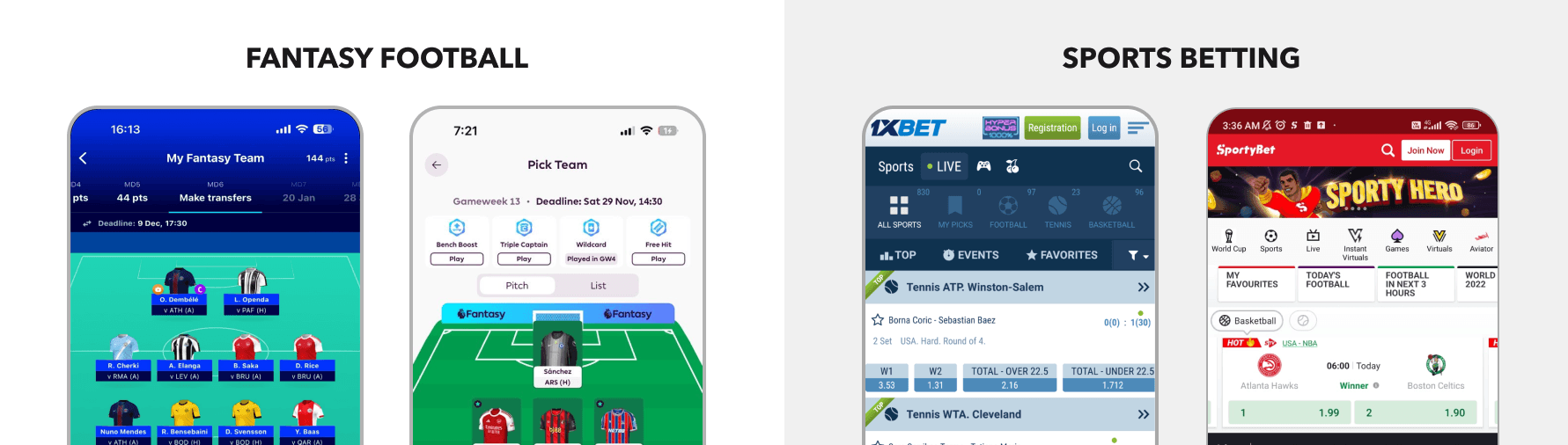
There was no one single product where fans could:
Play fantasy football across multiple major leagues.
Stake money.
Receive fast feedback and payouts.
Compete daily or weekly.
Control outcomes through squad decisions.
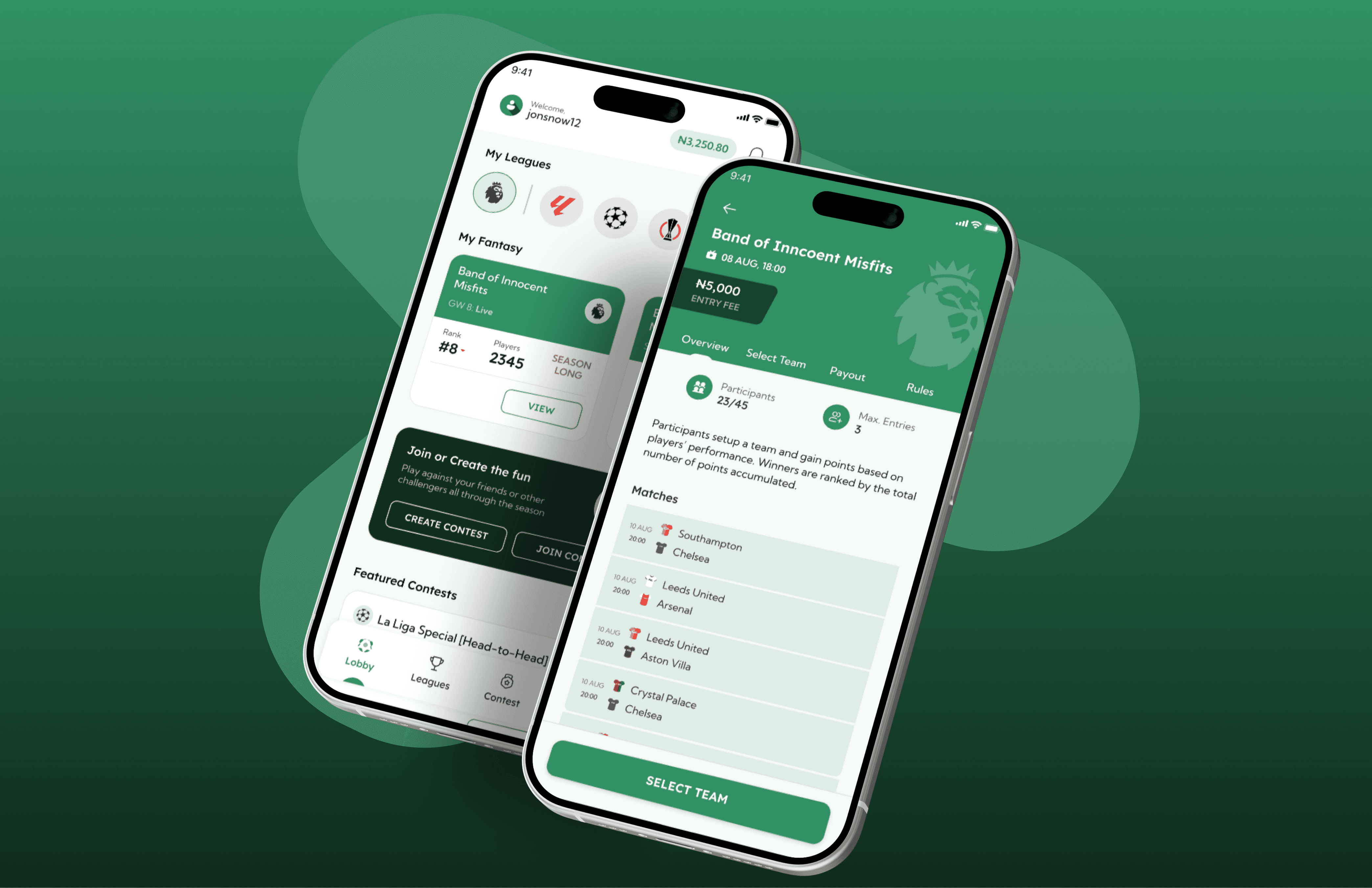
I began designing Fantasy Futbol, a mobile fantasy app featuring daily and season-long contests where users compete for real cash prizes.
THE GOAL
What we wanted to do was bring the decision-making depth of fantasy football into the speed and reward structure familiar to sports betting users. This was done across major football leagues worldwide (no other app had done this at that time).
This was not to replace existing fantasy platforms. This involved combining behaviors that most African football fans already practiced, but in separate products.
Before designing anything, I needed to understand those behaviors properly.
Drumroll…research.
RESEARCH INSIGHTS
My research focused on one question.
How do football fans in Africa already engage with competition, money, and fantasy?
I approached research in two layers.
First, market scanning.
I reviewed existing fantasy platforms available locally, mainly Premier League-focused products. I mapped their limitations:
Single league access: Most platforms locked users into one competition, usually the Premier League.
Long season commitment: Users had to stay engaged for months before seeing any reasonable conclusion.
No cash incentives: Winning delivered bragging rights, not real rewards.
Slow feedback cycles: Poor decisions early in the season punished users for weeks.
Next, sports betting behavior.
I also studied how users interact with betting apps. Not the features they interacted with, but their habits.
Quick entry: Users placed bets within seconds and expected zero setup friction.
Clear odds: Outcomes and rewards were visible before money left the wallet.
Immediate outcomes: Results landed mostly the same day or within one match window, depending on the bets chosen.
Frequent repeat usage: Users returned multiple times within a single matchday.
Emotional attachment to matchdays: Big fixtures drove spikes in activity and spending.
RESEARCH INSIGHTS
MARKET SIZE AND BEHAVIOR CONTEXT
Nigeria ranks among the top three countries globally by Fantasy Premier League managers, with over 500,000 registered users in a single season.
Sports betting penetration across major African markets exceeds 30 percent among football-following males aged 18 to 40.
MULTI-LEAGUE DEMAND PROOF
14 of 20 users interviewed actively followed more than one league weekly.
Champions League fixtures attracted higher engagement than domestic league games among casual users.
SPEED AND FEEDBACK VALIDATION
Most betting sessions lasted under 15 minutes. Although match analysis and decision-making might take longer.
18 out of 21 preferred outcomes resolved within 24 hours over season-long commitments.
Users ranked payout clarity as a top-three concern when staking money.
RESEARCH INSIGHTS
MARKET SIZE AND BEHAVIOR CONTEXT
Nigeria ranks among the top three countries globally by Fantasy Premier League managers, with over 500,000 registered users in a single season.
Sports betting penetration across major African markets exceeds 30 percent among football-following males aged 18 to 40.
MULTI-LEAGUE DEMAND PROOF
14 of 20 users interviewed actively followed more than one league weekly.
Champions League fixtures attracted higher engagement than domestic league games among casual users.
SPEED AND FEEDBACK VALIDATION
Most betting sessions lasted under 15 minutes. Although match analysis and decision-making might take longer.
18 out of 21 preferred outcomes resolved within 24 hours over season-long commitments.
Users ranked payout clarity as a top-three concern when staking money.
RESEARCH INSIGHTS
MARKET SIZE AND BEHAVIOR CONTEXT
Nigeria ranks among the top three countries globally by Fantasy Premier League managers, with over 500,000 registered users in a single season.
Sports betting penetration across major African markets exceeds 30 percent among football-following males aged 18 to 40.
MULTI-LEAGUE DEMAND PROOF
14 of 20 users interviewed actively followed more than one league weekly.
Champions League fixtures attracted higher engagement than domestic league games among casual users.
SPEED AND FEEDBACK VALIDATION
Most betting sessions lasted under 15 minutes. Although match analysis and decision-making might take longer.
18 out of 21 preferred outcomes resolved within 24 hours over season-long commitments.
Users ranked payout clarity as a top-three concern when staking money.
SPLASH SCREENS
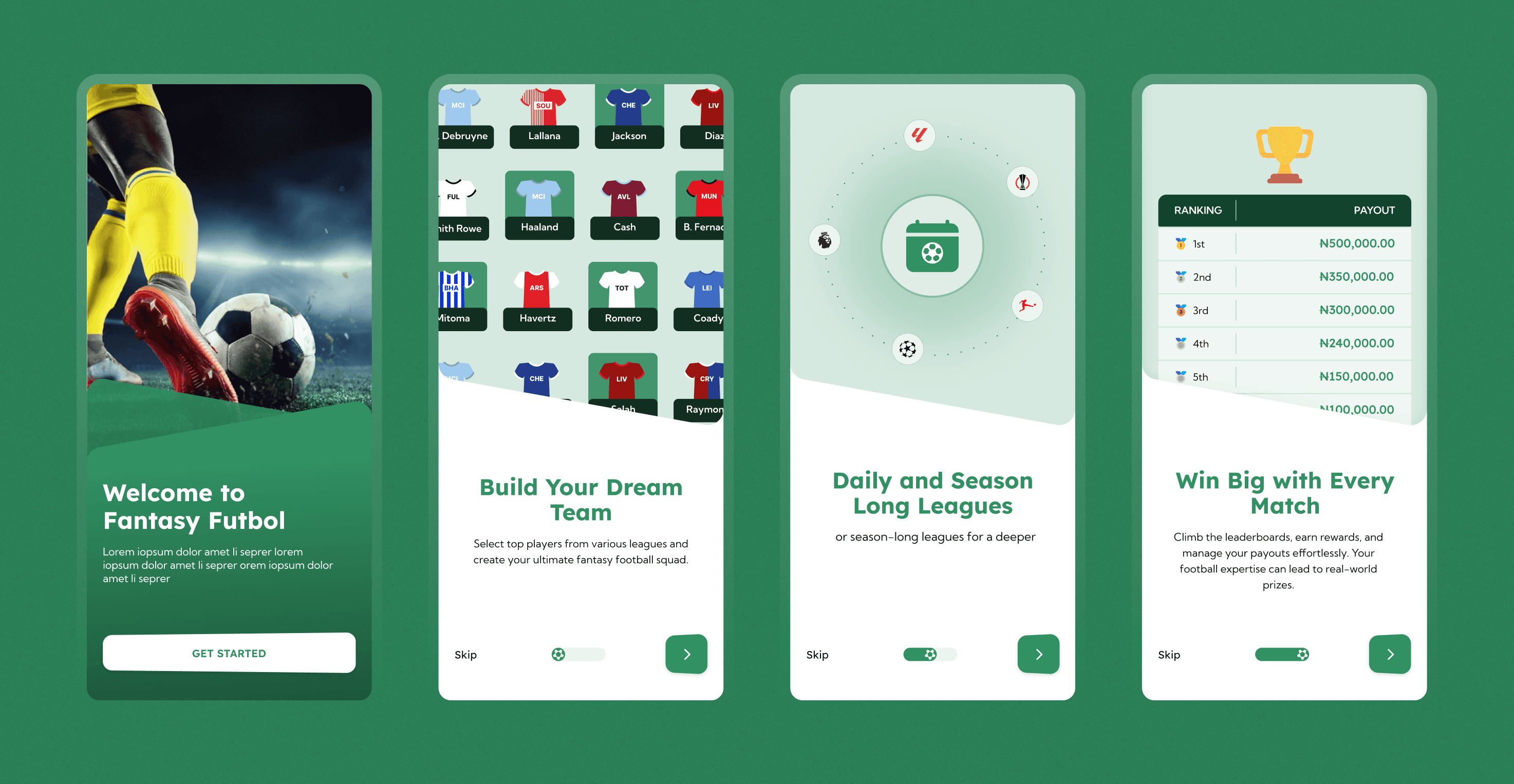
Research showed users already understood football and money. What they lacked was context. Onboarding existed to position the product, not teach it.
Also included was a Micro UI element - using a football as a slider.
SIGN UP/LOG IN
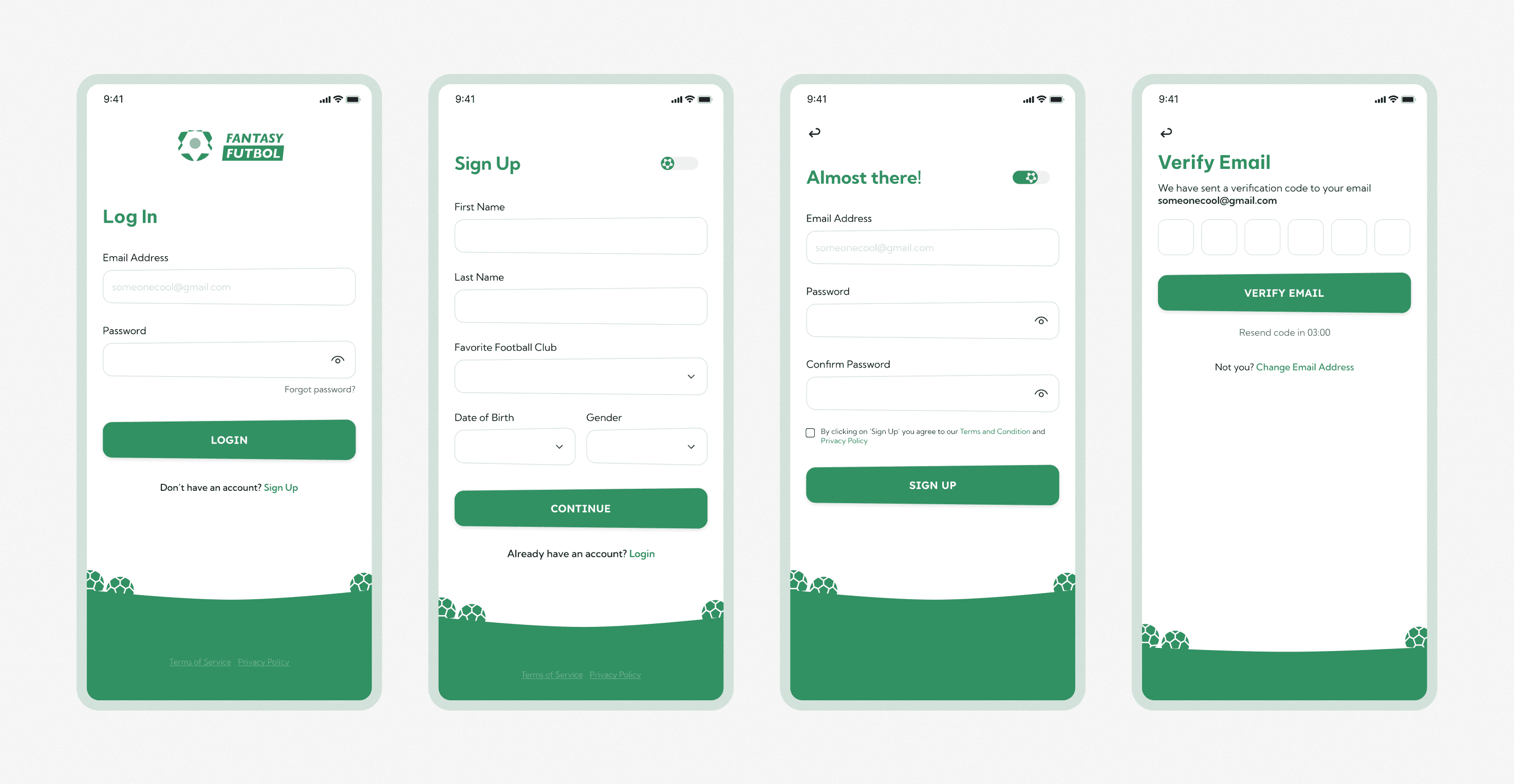
I removed everything not required to start playing. There was no profile setup, wallet funding or preference selection.
This decision came directly from betting behavior research. Users expect to act first and settle details later. Any delay before seeing the product core risk abandonment.
HOMEPAGE
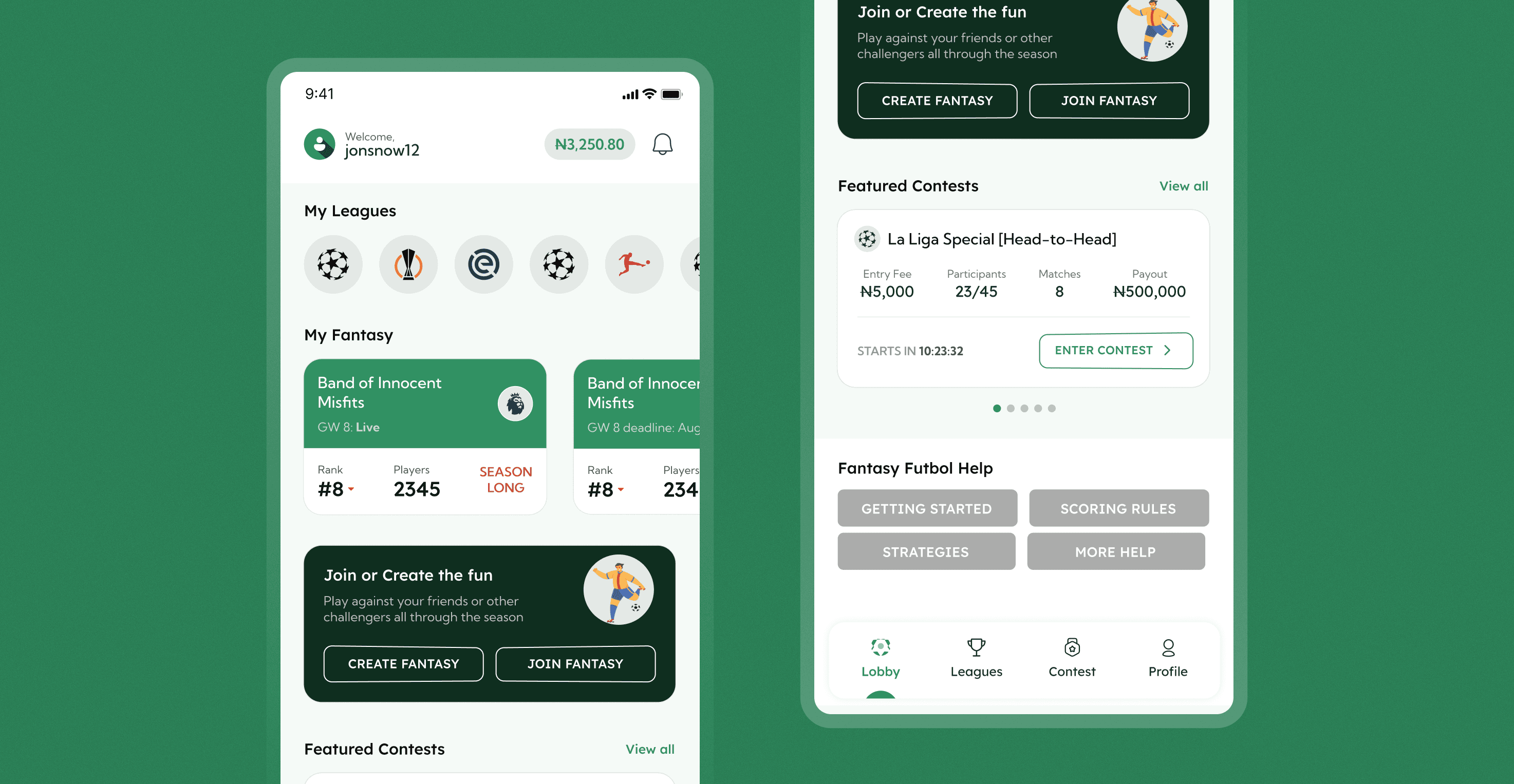
The homepage answered three major questions for users.
What am I currently involved in?
What is starting soon?
What should I do next?
The layout prioritized active leagues and contests at the top. This reflected real user behavior, as we found that users mostly returned to check the status, rather than browse.
SEASON LONG LEAGUES
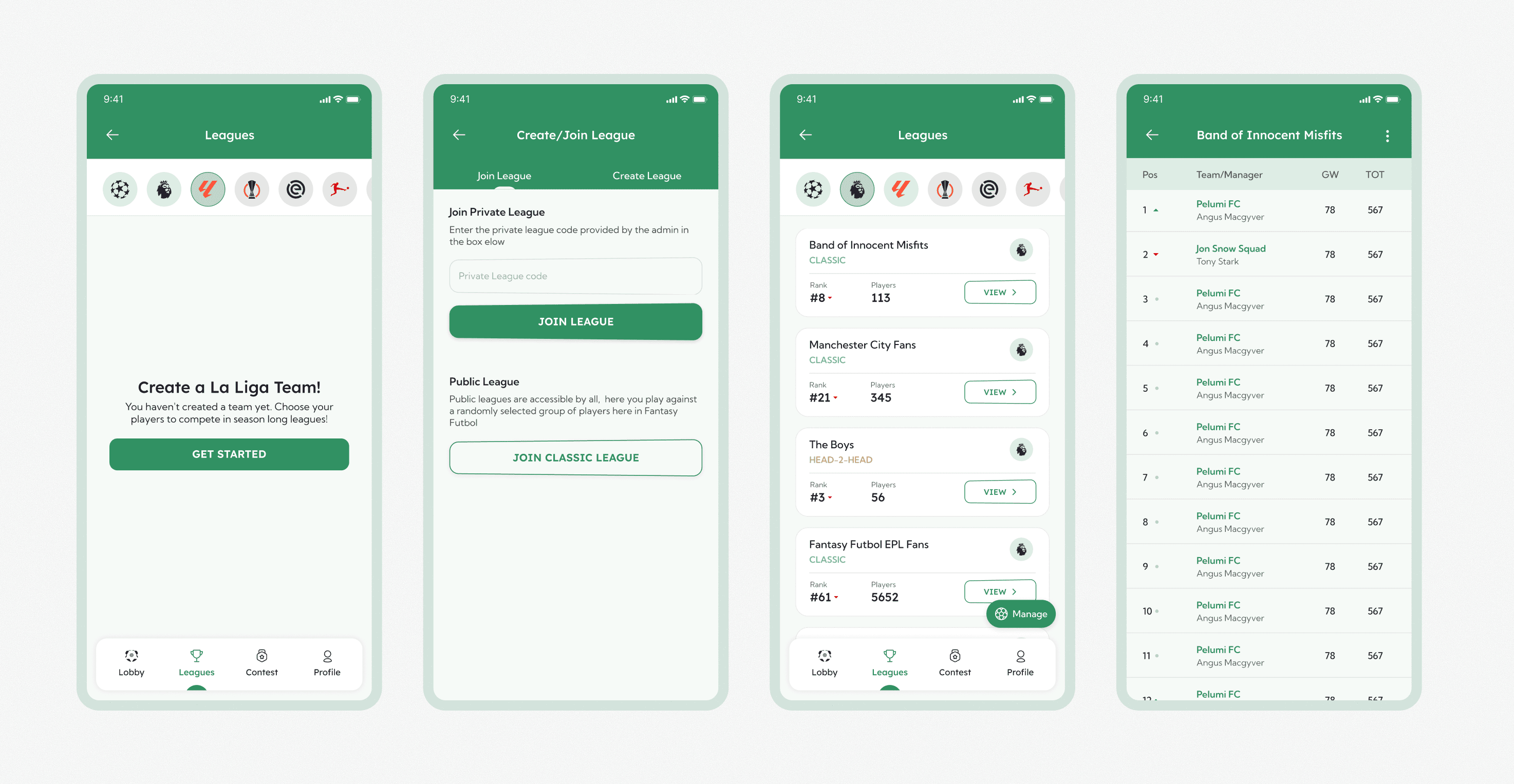
Many users already played fantasy football elsewhere. We didn’t change too much here. What we did was introduce multiple competition’s fantasy leagues accessible from one platform.
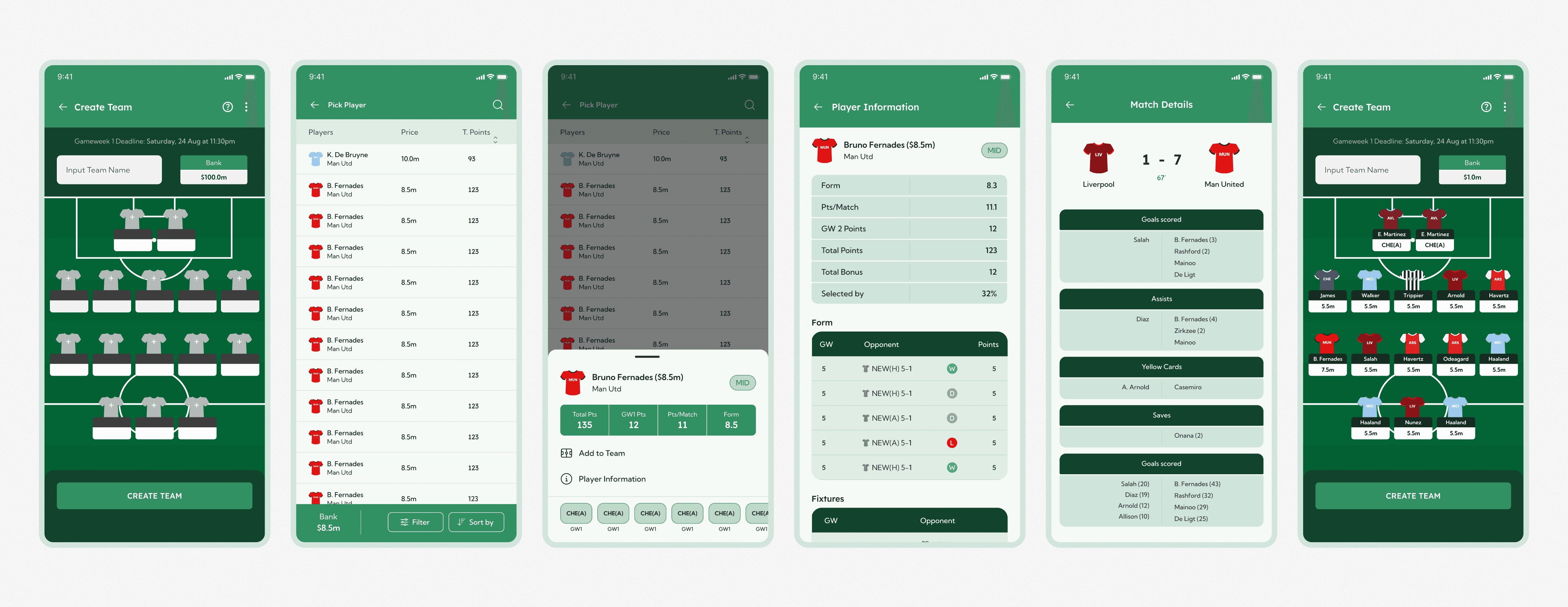
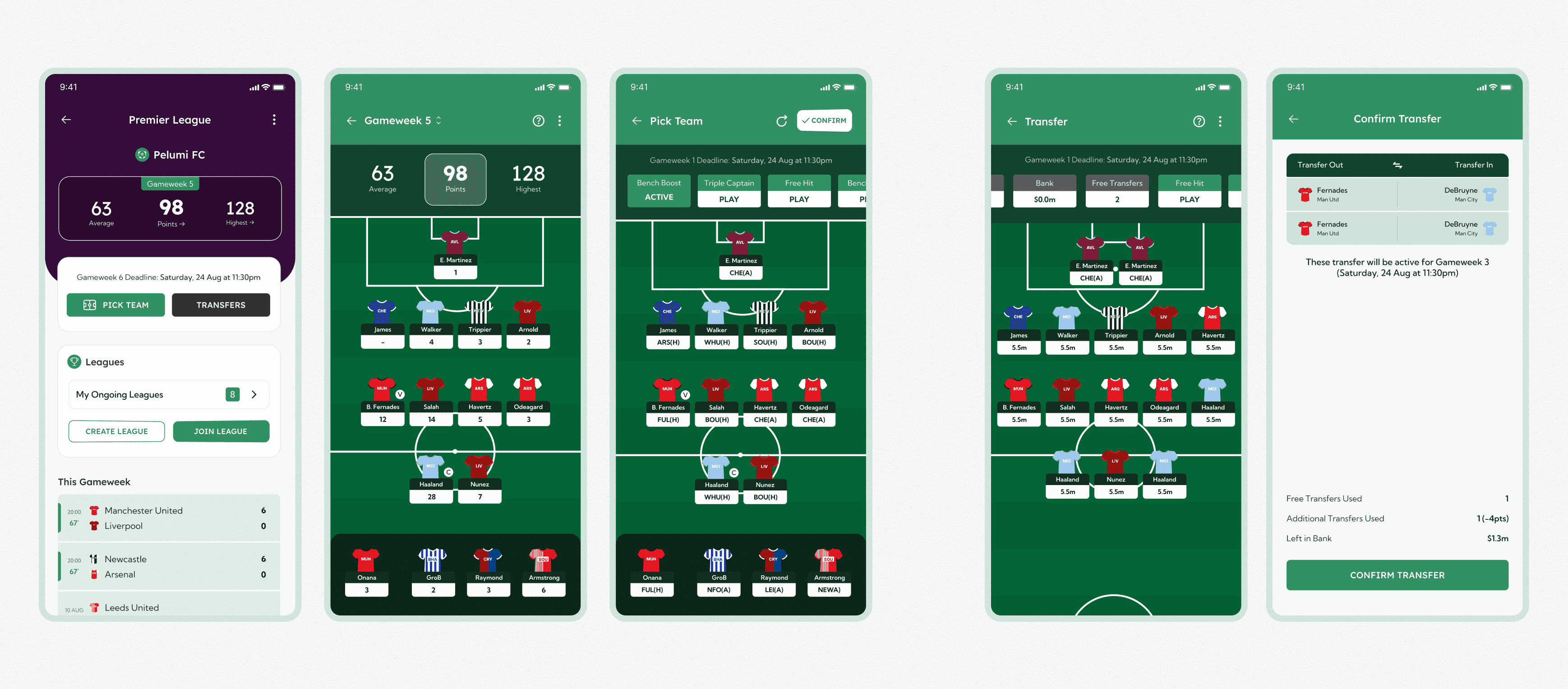
Team creation followed the same familiar patterns: One team per league, fixed budget and position constraints.
This mode rewarded patience and long-term thinking. It existed for users who still enjoyed the depth of fantasy football.
MANAGE LEAGUES
TEAM SELECTION
PICK TEAM/TRANSFERS
CONTESTS
This was the major part of the app, “the BIG IDEA”.
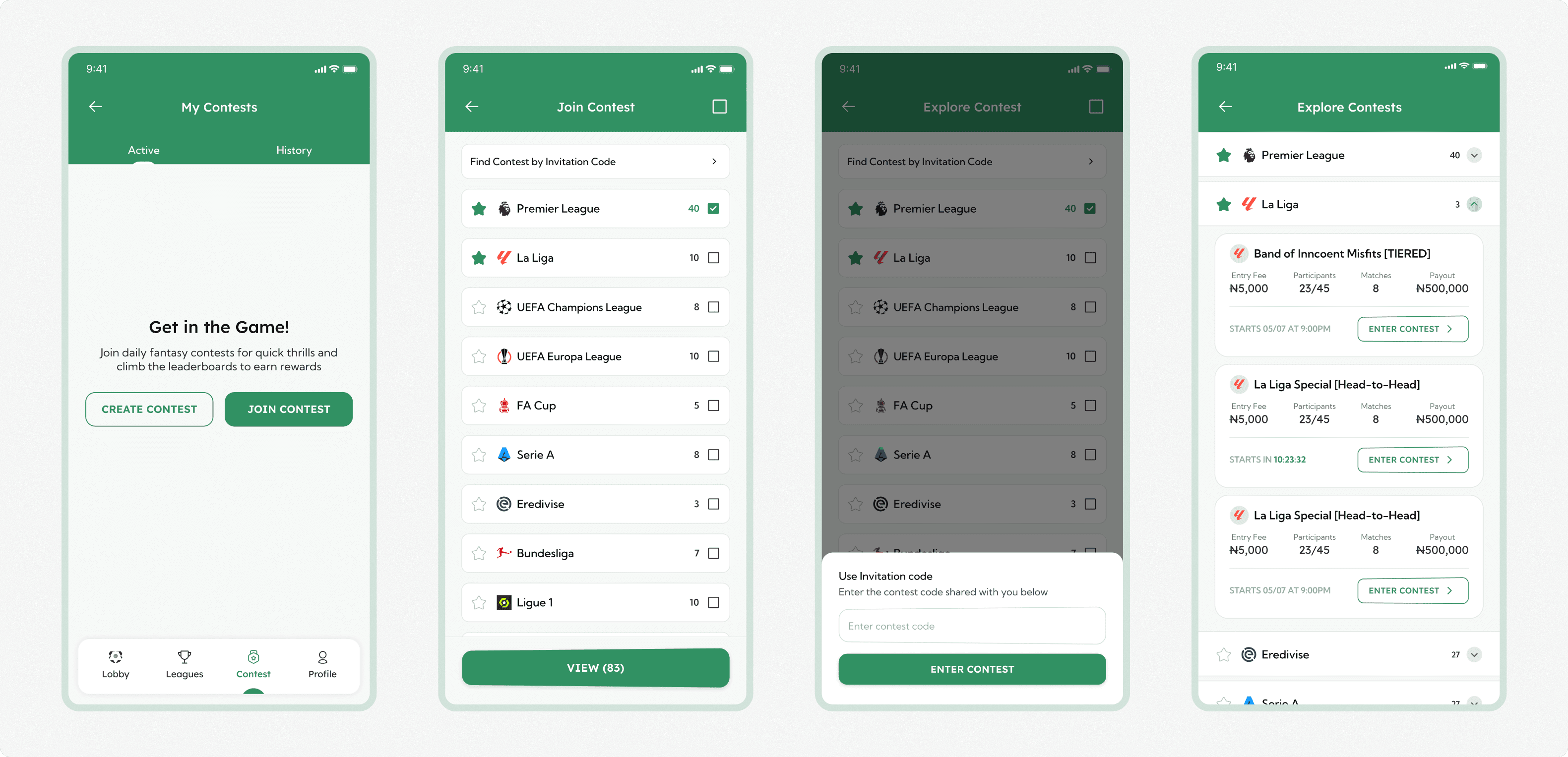
CONTEST BROWSING
Browsing contests felt closer to betting than to fantasy football.
Users can join a contest either through a shared invitation code or by exploring on their own, filtering by competitions to reduce scanning fatigue.
The contest cards showed only decision-critical information.
Entry fee.
Prize pool.
Payout structure.
Spots left/Total Spots.
CONTEST DETAILS
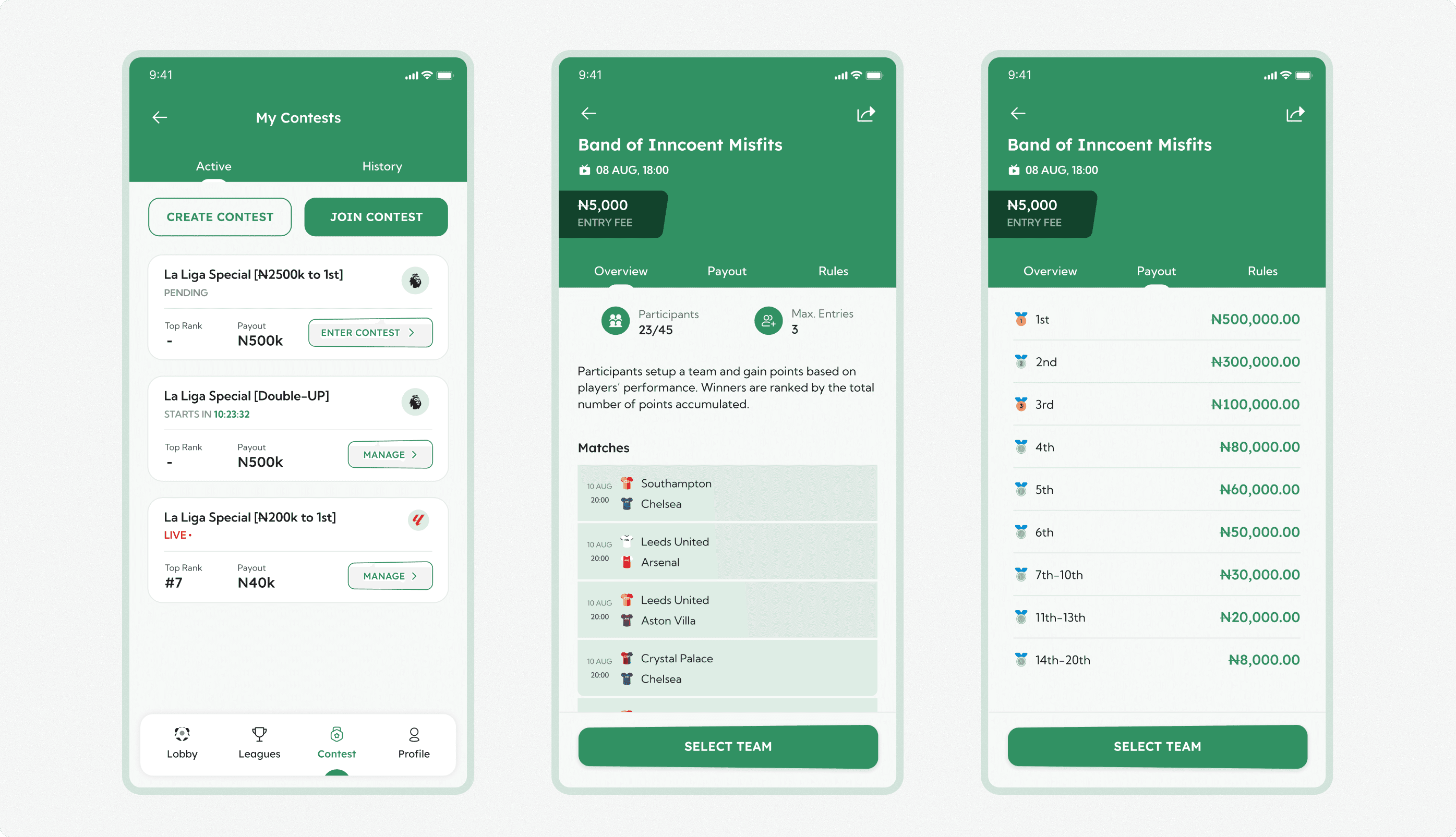
The information on the Contest Page was split into three sections(Overview, Payout, and Rules) with a major CTA to “Select a Team” and join the contest.
CONTEST CREATION
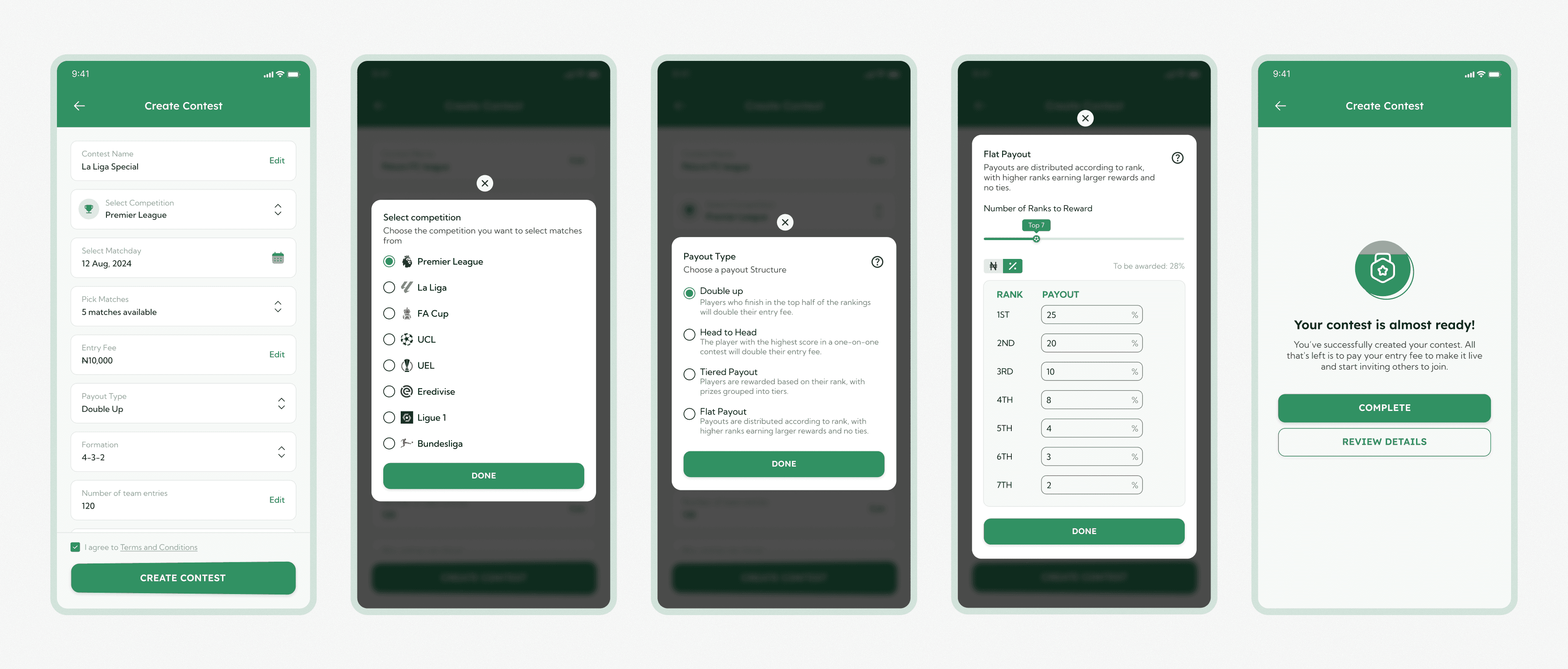
Contest creation served advanced users who understood fantasy and wanted control.
The flow followed a logical sequence: Choose the league and fixtures, define entry economics, choose payout structure, and set limits.
A key decision happened at the end. Creators paid their own entry fee before the contest went live. This solved multiple problems by preventing fake contests and signaling commitment. Ensuring only serious contests reached the public list.
MANAGE CONTEST
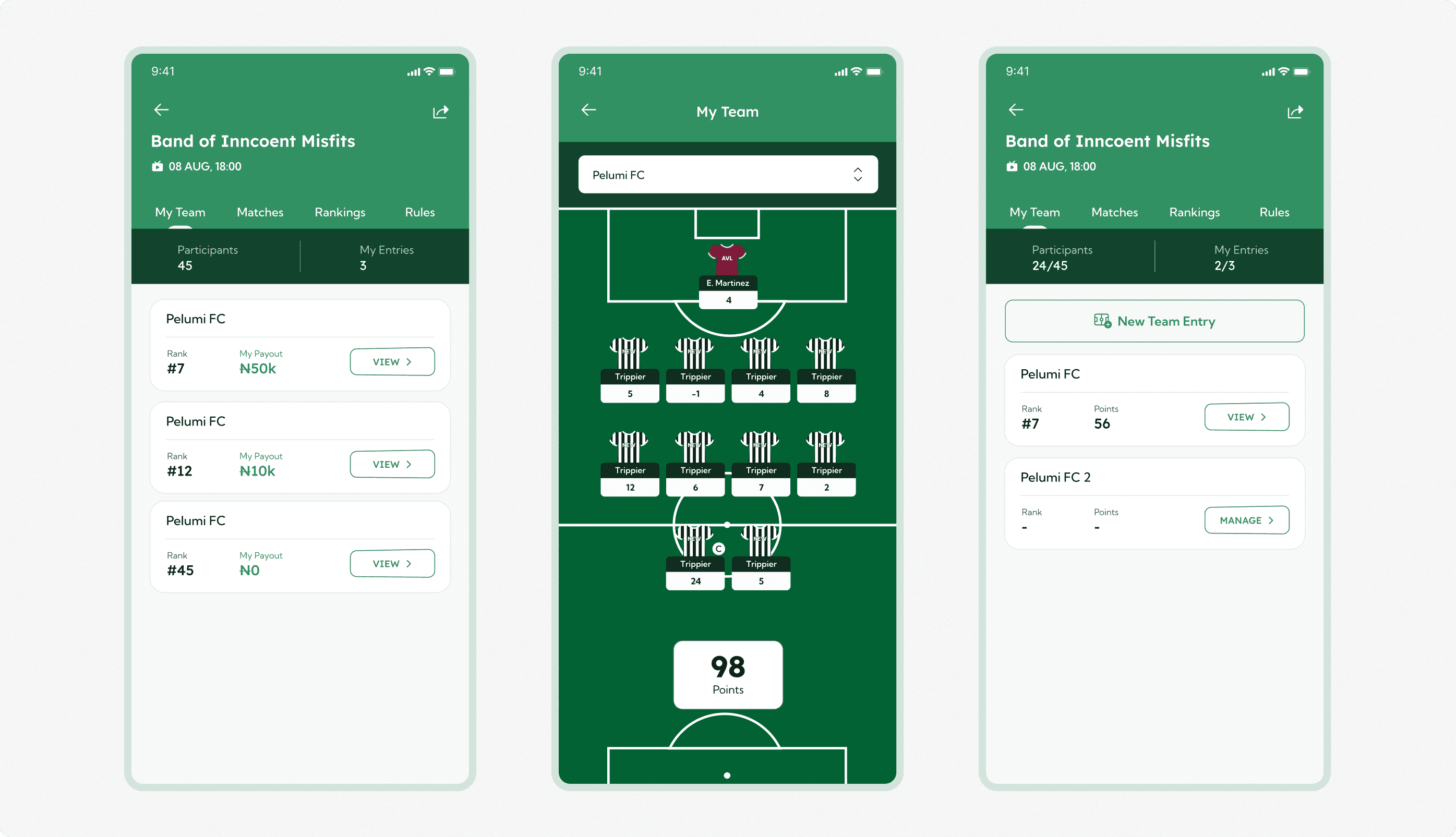
Once a contest is active or has been played, a user can see their rankings, view the performance of the players in their team(s), and view their payouts if any.
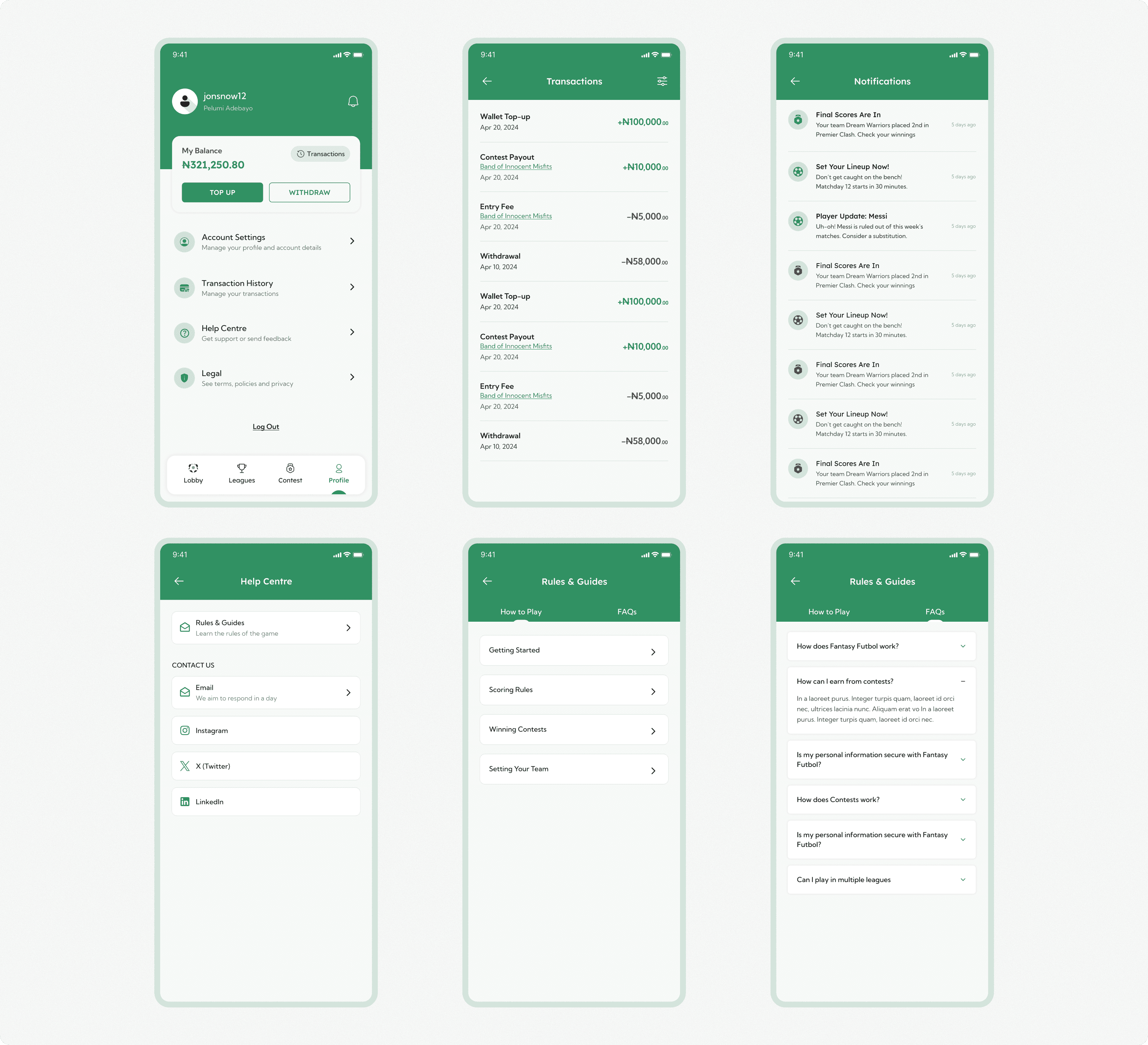
PROFILE
The profile page housed the wallet, account settings, help(rules, how to play, faqs etc.)
LANDING PAGE
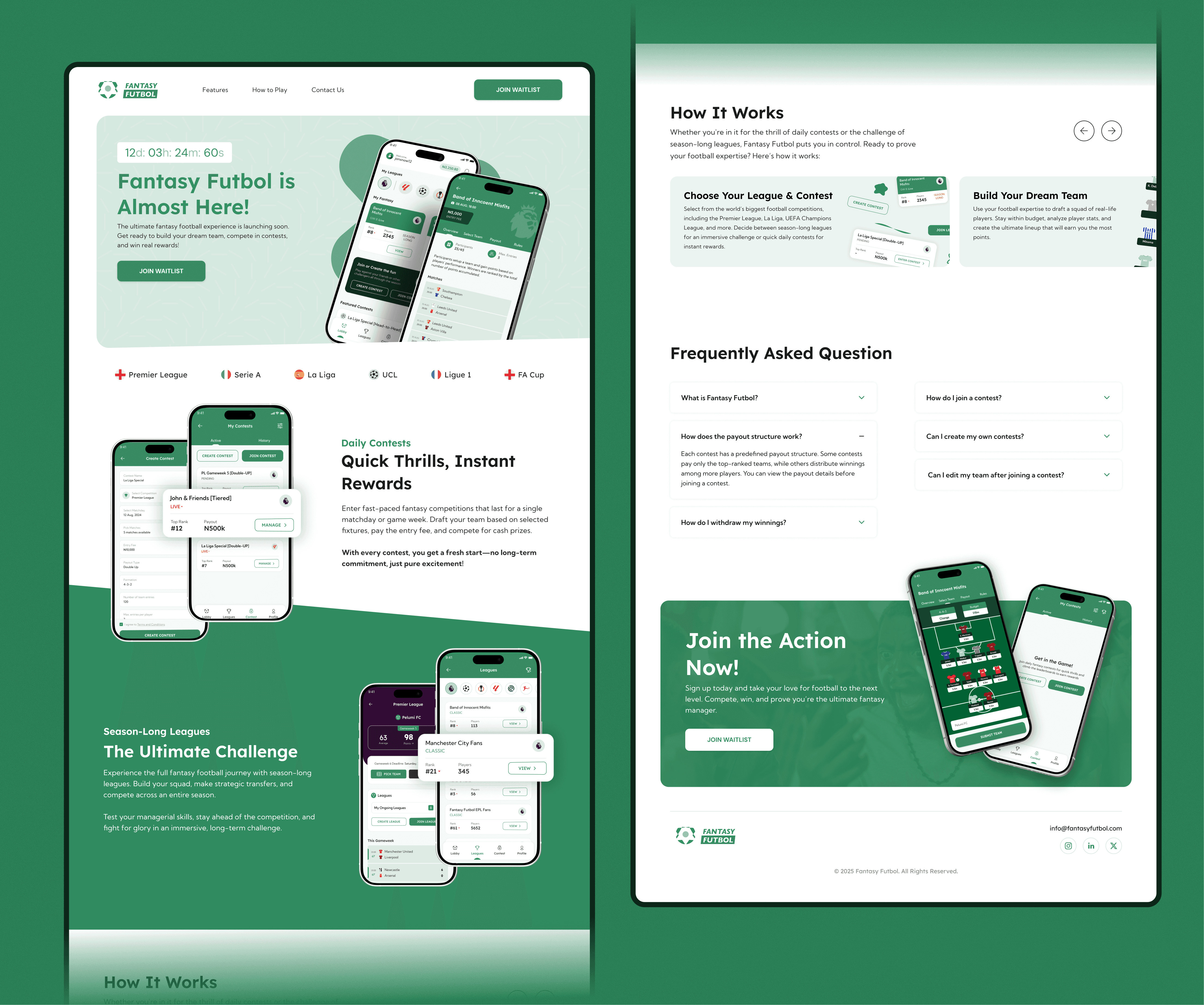
OUTCOME
Fantasy Futbol shipped as a complete product. Users gained access to multiple major football leagues in one place. Daily contests gave immediate feedback while season-long leagues supported long-term strategy. Wallet payouts closed the loop between skill and reward.
The most important outcome was that:
Users understood what they joined.
Users understood how they won.
Users understood how money moved.
For you as a reader, the outcome shows one thing clearly. Product success here did not come from anything really new; it came from an alignment with existing user behaviors.
REFLECTION
This project reshaped how I think about designing sports products or a market where money, emotion, and trust intersect. Working on Fantasy Futbol made it clear that once real cash enters an experience, user behavior changes immediately, and small design decisions carry far more weight than they would in a non-monetized product.
I learned how much anxiety money introduces into the user experience. An unclear rule does not feel minor anymore; it feels risky. A missing explanation does not feel optional; it feels suspicious.
This forced me to design with restraint, focusing on clarity, hierarchy, and predictability instead of visual novelty or clever interactions. Every screen needed to answer questions before users had to ask them.
Thanks for your time!
FANTASY FUTBOL
A High-Stakes Fantasy Football Experience.
Fantasy Futbol is a project for a real-money fantasy football platform for African users.
Year
2025
Industry
Sport
Client
Fantasy Futbol
Project Duration
2 months
PROJECT SCOPE
Fantasy Futbol was a project for a client building a real-money fantasy football platform for African users.
At the time, the market offered two separate experiences.
Traditional fantasy football platforms focused on a single league, mostly the Premier League, with season-long commitment and no cash rewards.
Sports betting platforms focused on fast outcomes, staking, and payouts, but removed control from the fan. Users placed bets and waited.
There was no one single product where fans could:
Play fantasy football across multiple major leagues.
Stake money.
Receive fast feedback and payouts.
Compete daily or weekly.
Control outcomes through squad decisions.
I began designing Fantasy Futbol, a mobile fantasy app featuring daily and season-long contests where users compete for real cash prizes.
THE GOAL
What we wanted to do was bring the decision-making depth of fantasy football into the speed and reward structure familiar to sports betting users. This was done across major football leagues worldwide (no other app had done this at that time).
This was not to replace existing fantasy platforms. This involved combining behaviors that most African football fans already practiced, but in separate products.
Before designing anything, I needed to understand those behaviors properly.
Drumroll…research.
RESEARCH INSIGHTS
My research focused on one question.
How do football fans in Africa already engage with competition, money, and fantasy?
I approached research in two layers.
First, market scanning.
I reviewed existing fantasy platforms available locally, mainly Premier League-focused products. I mapped their limitations:
Single league access: Most platforms locked users into one competition, usually the Premier League.
Long season commitment: Users had to stay engaged for months before seeing any reasonable conclusion.
No cash incentives: Winning delivered bragging rights, not real rewards.
Slow feedback cycles: Poor decisions early in the season punished users for weeks.
Next, sports betting behavior.
I also studied how users interact with betting apps. Not the features they interacted with, but their habits.
Quick entry: Users placed bets within seconds and expected zero setup friction.
Clear odds: Outcomes and rewards were visible before money left the wallet.
Immediate outcomes: Results landed mostly the same day or within one match window, depending on the bets chosen.
Frequent repeat usage: Users returned multiple times within a single matchday.
Emotional attachment to matchdays: Big fixtures drove spikes in activity and spending.
RESEARCH INSIGHTS
MARKET SIZE AND BEHAVIOR CONTEXT
Nigeria ranks among the top three countries globally by Fantasy Premier League managers, with over 500,000 registered users in a single season.
Sports betting penetration across major African markets exceeds 30 percent among football-following males aged 18 to 40.
MULTI-LEAGUE DEMAND PROOF
14 of 20 users interviewed actively followed more than one league weekly.
Champions League fixtures attracted higher engagement than domestic league games among casual users.
SPEED AND FEEDBACK VALIDATION
Most betting sessions lasted under 15 minutes. Although match analysis and decision-making might take longer.
18 out of 21 preferred outcomes resolved within 24 hours over season-long commitments.
Users ranked payout clarity as a top-three concern when staking money.
RESEARCH INSIGHTS
MARKET SIZE AND BEHAVIOR CONTEXT
Nigeria ranks among the top three countries globally by Fantasy Premier League managers, with over 500,000 registered users in a single season.
Sports betting penetration across major African markets exceeds 30 percent among football-following males aged 18 to 40.
MULTI-LEAGUE DEMAND PROOF
14 of 20 users interviewed actively followed more than one league weekly.
Champions League fixtures attracted higher engagement than domestic league games among casual users.
SPEED AND FEEDBACK VALIDATION
Most betting sessions lasted under 15 minutes. Although match analysis and decision-making might take longer.
18 out of 21 preferred outcomes resolved within 24 hours over season-long commitments.
Users ranked payout clarity as a top-three concern when staking money.
RESEARCH INSIGHTS
MARKET SIZE AND BEHAVIOR CONTEXT
Nigeria ranks among the top three countries globally by Fantasy Premier League managers, with over 500,000 registered users in a single season.
Sports betting penetration across major African markets exceeds 30 percent among football-following males aged 18 to 40.
MULTI-LEAGUE DEMAND PROOF
14 of 20 users interviewed actively followed more than one league weekly.
Champions League fixtures attracted higher engagement than domestic league games among casual users.
SPEED AND FEEDBACK VALIDATION
Most betting sessions lasted under 15 minutes. Although match analysis and decision-making might take longer.
18 out of 21 preferred outcomes resolved within 24 hours over season-long commitments.
Users ranked payout clarity as a top-three concern when staking money.
SPLASH SCREENS
Research showed users already understood football and money. What they lacked was context. Onboarding existed to position the product, not teach it.
Also included was a Micro UI element - using a football as a slider.
SIGN UP/LOG IN
I removed everything not required to start playing. There was no profile setup, wallet funding or preference selection.
This decision came directly from betting behavior research. Users expect to act first and settle details later. Any delay before seeing the product core risk abandonment.
HOMEPAGE
The homepage answered three major questions for users.
What am I currently involved in?
What is starting soon?
What should I do next?
The layout prioritized active leagues and contests at the top. This reflected real user behavior, as we found that users mostly returned to check the status, rather than browse.
SEASON LONG LEAGUES
Many users already played fantasy football elsewhere. We didn’t change too much here. What we did was introduce multiple competition’s fantasy leagues accessible from one platform.
Team creation followed the same familiar patterns: One team per league, fixed budget and position constraints.
This mode rewarded patience and long-term thinking. It existed for users who still enjoyed the depth of fantasy football.
MANAGE LEAGUES
TEAM SELECTION
PICK TEAM/TRANSFERS
CONTESTS
This was the major part of the app, “the BIG IDEA”.
CONTEST BROWSING
Browsing contests felt closer to betting than to fantasy football.
Users can join a contest either through a shared invitation code or by exploring on their own, filtering by competitions to reduce scanning fatigue.
The contest cards showed only decision-critical information.
Entry fee.
Prize pool.
Payout structure.
Spots left/Total Spots.
CONTEST DETAILS
The information on the Contest Page was split into three sections(Overview, Payout, and Rules) with a major CTA to “Select a Team” and join the contest.
CONTEST CREATION
Contest creation served advanced users who understood fantasy and wanted control.
The flow followed a logical sequence: Choose the league and fixtures, define entry economics, choose payout structure, and set limits.
A key decision happened at the end. Creators paid their own entry fee before the contest went live. This solved multiple problems by preventing fake contests and signaling commitment. Ensuring only serious contests reached the public list.
MANAGE CONTEST
Once a contest is active or has been played, a user can see their rankings, view the performance of the players in their team(s), and view their payouts if any.
PROFILE
The profile page housed the wallet, account settings, help(rules, how to play, faqs etc.)
LANDING PAGE
OUTCOME
Fantasy Futbol shipped as a complete product. Users gained access to multiple major football leagues in one place. Daily contests gave immediate feedback while season-long leagues supported long-term strategy. Wallet payouts closed the loop between skill and reward.
The most important outcome was that:
Users understood what they joined.
Users understood how they won.
Users understood how money moved.
For you as a reader, the outcome shows one thing clearly. Product success here did not come from anything really new; it came from an alignment with existing user behaviors.
REFLECTION
This project reshaped how I think about designing sports products or a market where money, emotion, and trust intersect. Working on Fantasy Futbol made it clear that once real cash enters an experience, user behavior changes immediately, and small design decisions carry far more weight than they would in a non-monetized product.
I learned how much anxiety money introduces into the user experience. An unclear rule does not feel minor anymore; it feels risky. A missing explanation does not feel optional; it feels suspicious.
This forced me to design with restraint, focusing on clarity, hierarchy, and predictability instead of visual novelty or clever interactions. Every screen needed to answer questions before users had to ask them.
Thanks for your time!
FANTASY FUTBOL
A High-Stakes Fantasy Football Experience.
Fantasy Futbol is a project for a real-money fantasy football platform for African users.
Year
2025
Industry
Sport
Client
Fantasy Futbol
Project Duration
2 months
PROJECT SCOPE
Fantasy Futbol was a project for a client building a real-money fantasy football platform for African users.
At the time, the market offered two separate experiences.
Traditional fantasy football platforms focused on a single league, mostly the Premier League, with season-long commitment and no cash rewards.
Sports betting platforms focused on fast outcomes, staking, and payouts, but removed control from the fan. Users placed bets and waited.
There was no one single product where fans could:
Play fantasy football across multiple major leagues.
Stake money.
Receive fast feedback and payouts.
Compete daily or weekly.
Control outcomes through squad decisions.
I began designing Fantasy Futbol, a mobile fantasy app featuring daily and season-long contests where users compete for real cash prizes.
THE GOAL
What we wanted to do was bring the decision-making depth of fantasy football into the speed and reward structure familiar to sports betting users. This was done across major football leagues worldwide (no other app had done this at that time).
This was not to replace existing fantasy platforms. This involved combining behaviors that most African football fans already practiced, but in separate products.
Before designing anything, I needed to understand those behaviors properly.
Drumroll…research.
RESEARCH INSIGHTS
My research focused on one question.
How do football fans in Africa already engage with competition, money, and fantasy?
I approached research in two layers.
First, market scanning.
I reviewed existing fantasy platforms available locally, mainly Premier League-focused products. I mapped their limitations:
Single league access: Most platforms locked users into one competition, usually the Premier League.
Long season commitment: Users had to stay engaged for months before seeing any reasonable conclusion.
No cash incentives: Winning delivered bragging rights, not real rewards.
Slow feedback cycles: Poor decisions early in the season punished users for weeks.
Next, sports betting behavior.
I also studied how users interact with betting apps. Not the features they interacted with, but their habits.
Quick entry: Users placed bets within seconds and expected zero setup friction.
Clear odds: Outcomes and rewards were visible before money left the wallet.
Immediate outcomes: Results landed mostly the same day or within one match window, depending on the bets chosen.
Frequent repeat usage: Users returned multiple times within a single matchday.
Emotional attachment to matchdays: Big fixtures drove spikes in activity and spending.
RESEARCH INSIGHTS
MARKET SIZE AND BEHAVIOR CONTEXT
Nigeria ranks among the top three countries globally by Fantasy Premier League managers, with over 500,000 registered users in a single season.
Sports betting penetration across major African markets exceeds 30 percent among football-following males aged 18 to 40.
MULTI-LEAGUE DEMAND PROOF
14 of 20 users interviewed actively followed more than one league weekly.
Champions League fixtures attracted higher engagement than domestic league games among casual users.
SPEED AND FEEDBACK VALIDATION
Most betting sessions lasted under 15 minutes. Although match analysis and decision-making might take longer.
18 out of 21 preferred outcomes resolved within 24 hours over season-long commitments.
Users ranked payout clarity as a top-three concern when staking money.
RESEARCH INSIGHTS
MARKET SIZE AND BEHAVIOR CONTEXT
Nigeria ranks among the top three countries globally by Fantasy Premier League managers, with over 500,000 registered users in a single season.
Sports betting penetration across major African markets exceeds 30 percent among football-following males aged 18 to 40.
MULTI-LEAGUE DEMAND PROOF
14 of 20 users interviewed actively followed more than one league weekly.
Champions League fixtures attracted higher engagement than domestic league games among casual users.
SPEED AND FEEDBACK VALIDATION
Most betting sessions lasted under 15 minutes. Although match analysis and decision-making might take longer.
18 out of 21 preferred outcomes resolved within 24 hours over season-long commitments.
Users ranked payout clarity as a top-three concern when staking money.
RESEARCH INSIGHTS
MARKET SIZE AND BEHAVIOR CONTEXT
Nigeria ranks among the top three countries globally by Fantasy Premier League managers, with over 500,000 registered users in a single season.
Sports betting penetration across major African markets exceeds 30 percent among football-following males aged 18 to 40.
MULTI-LEAGUE DEMAND PROOF
14 of 20 users interviewed actively followed more than one league weekly.
Champions League fixtures attracted higher engagement than domestic league games among casual users.
SPEED AND FEEDBACK VALIDATION
Most betting sessions lasted under 15 minutes. Although match analysis and decision-making might take longer.
18 out of 21 preferred outcomes resolved within 24 hours over season-long commitments.
Users ranked payout clarity as a top-three concern when staking money.
SPLASH SCREENS
Research showed users already understood football and money. What they lacked was context. Onboarding existed to position the product, not teach it.
Also included was a Micro UI element - using a football as a slider.
SIGN UP/LOG IN
I removed everything not required to start playing. There was no profile setup, wallet funding or preference selection.
This decision came directly from betting behavior research. Users expect to act first and settle details later. Any delay before seeing the product core risk abandonment.
HOMEPAGE
The homepage answered three major questions for users.
What am I currently involved in?
What is starting soon?
What should I do next?
The layout prioritized active leagues and contests at the top. This reflected real user behavior, as we found that users mostly returned to check the status, rather than browse.
SEASON LONG LEAGUES
Many users already played fantasy football elsewhere. We didn’t change too much here. What we did was introduce multiple competition’s fantasy leagues accessible from one platform.
Team creation followed the same familiar patterns: One team per league, fixed budget and position constraints.
This mode rewarded patience and long-term thinking. It existed for users who still enjoyed the depth of fantasy football.
MANAGE LEAGUES
TEAM SELECTION
PICK TEAM/TRANSFERS
CONTESTS
This was the major part of the app, “the BIG IDEA”.
CONTEST BROWSING
Browsing contests felt closer to betting than to fantasy football.
Users can join a contest either through a shared invitation code or by exploring on their own, filtering by competitions to reduce scanning fatigue.
The contest cards showed only decision-critical information.
Entry fee.
Prize pool.
Payout structure.
Spots left/Total Spots.
CONTEST DETAILS
The information on the Contest Page was split into three sections(Overview, Payout, and Rules) with a major CTA to “Select a Team” and join the contest.
CONTEST CREATION
Contest creation served advanced users who understood fantasy and wanted control.
The flow followed a logical sequence: Choose the league and fixtures, define entry economics, choose payout structure, and set limits.
A key decision happened at the end. Creators paid their own entry fee before the contest went live. This solved multiple problems by preventing fake contests and signaling commitment. Ensuring only serious contests reached the public list.
MANAGE CONTEST
Once a contest is active or has been played, a user can see their rankings, view the performance of the players in their team(s), and view their payouts if any.
PROFILE
The profile page housed the wallet, account settings, help(rules, how to play, faqs etc.)
LANDING PAGE
OUTCOME
Fantasy Futbol shipped as a complete product. Users gained access to multiple major football leagues in one place. Daily contests gave immediate feedback while season-long leagues supported long-term strategy. Wallet payouts closed the loop between skill and reward.
The most important outcome was that:
Users understood what they joined.
Users understood how they won.
Users understood how money moved.
For you as a reader, the outcome shows one thing clearly. Product success here did not come from anything really new; it came from an alignment with existing user behaviors.
REFLECTION
This project reshaped how I think about designing sports products or a market where money, emotion, and trust intersect. Working on Fantasy Futbol made it clear that once real cash enters an experience, user behavior changes immediately, and small design decisions carry far more weight than they would in a non-monetized product.
I learned how much anxiety money introduces into the user experience. An unclear rule does not feel minor anymore; it feels risky. A missing explanation does not feel optional; it feels suspicious.
This forced me to design with restraint, focusing on clarity, hierarchy, and predictability instead of visual novelty or clever interactions. Every screen needed to answer questions before users had to ask them.
Thanks for your time!