ZOFFIE
Designing A Hiring Platform Around Intent.
Zoffie is a live hiring platform built to help companies hire and help job seekers apply with intent. The product challenges the common hiring model where employers are overwhelmed with low-quality applications, and candidates apply without enough context.
Year
2025
Industry
SaaS
Client
Simar
Project Duration
6 weeks
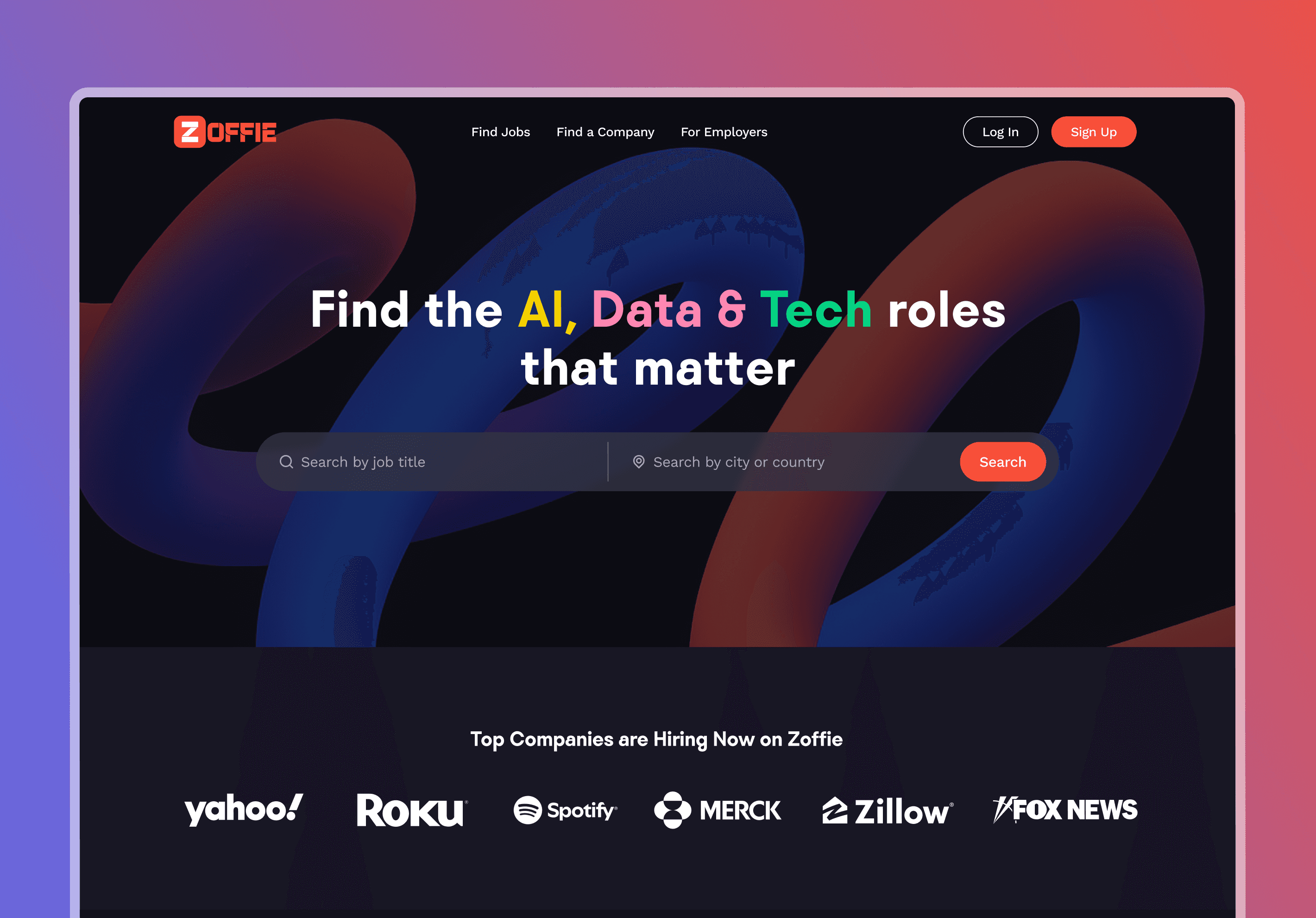
PROBLEM SPACE
When I started looking closely at hiring platforms, I noticed a consistent pattern. Most platforms are designed to increase activity through more postings and more applications. Success is often measured by the number of candidates who apply, rather than by the number who are actually qualified.
I interviewed with several recruiters, and their frustration was palpable.
Several hiring managers described receiving over 100 applications within days, with only a small fraction being relevant. Many applicants lacked the required skills or misunderstood the role entirely.
On the jobseeker side, a different but connected problem appeared.
Candidates described applying without clarity. Salary ranges were missing, and role expectations were mostly vague. Company information was limited or nonexistent most times. Many job seekers said they applied based on titles alone, hoping the details would become clear later.
One candidate explained that applying felt like a gamble. Another said they often realized a role was a poor fit only after receiving a response, which wasted time on both sides.
Filtering tools and ATS features were intended to solve the problem after applications arrived. Our research showed the problem started much earlier, at the point of understanding and intent.
THE GOAL
To create a permanent, centralized digital archive where loved ones can share memories, stories, photos, and key life moments in a peaceful, dignified environment.
THE Challenge
Existing memorial platforms often feel dark, old-fashioned, or emotionally heavy. We needed the exact opposite.
Life-first, not death-first.
RESEARCH AND VALIDATION
To confirm this, I conducted interviews with employers and active job seekers across different roles and company sizes. These were semi-structured conversations focused on recent hiring or application experiences.
Employers highlighted three recurring issues.
Too many applications from candidates who did not understand the role.
Job descriptions copied from templates without real context.
No consistent way to evaluate candidates beyond resumes.
Job seekers raised their own set of pain points.
Unclear salary and expectations before applying.
Limited information about the company or team.
Little feedback or visibility after submitting applications.
Employers wanted candidates who applied with intent. Jobseekers wanted enough context to decide whether a role was worth applying for.
Instead of focusing on better filters, Zoffie needed to focus on better context. Instead of optimizing for application volume, the system needed to encourage informed decisions on both sides before an application ever happened.
This insight became the foundation for how jobs were posted, how company profiles were designed, and how applications were structured end-to-end.
DESIGN PRINCIPLES
Four principles guided the product.
Clarity : Every job and company should be understood before applying.
Signal over volume: Fewer applications with higher intent beat mass submissions.
Structure without rigidity: Support real workflows without forcing rigid ATS behavior.
Respect existing tools: Track hiring decisions without replacing calendars or email.
USER FLOWS
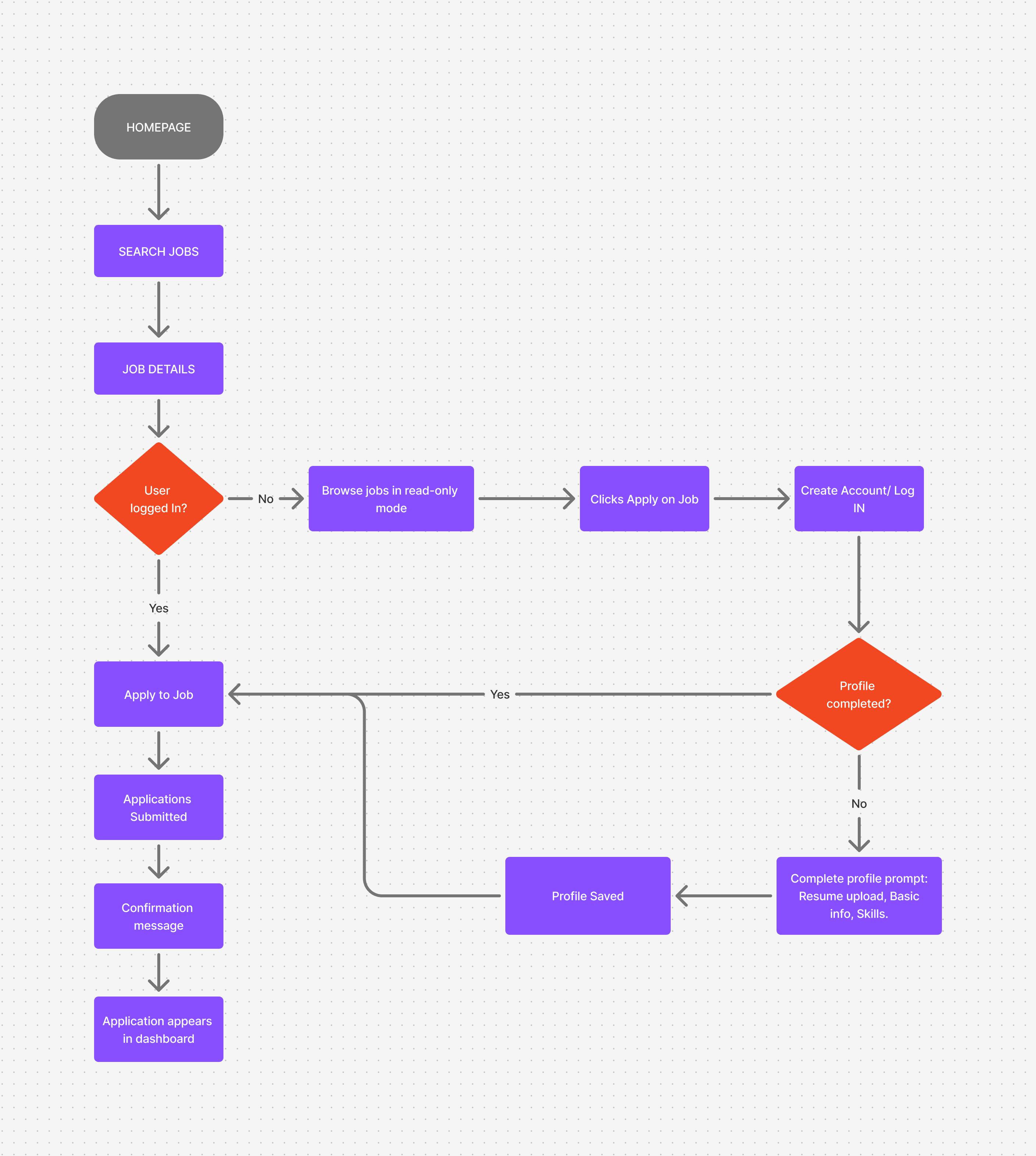
Job Seekers Flow
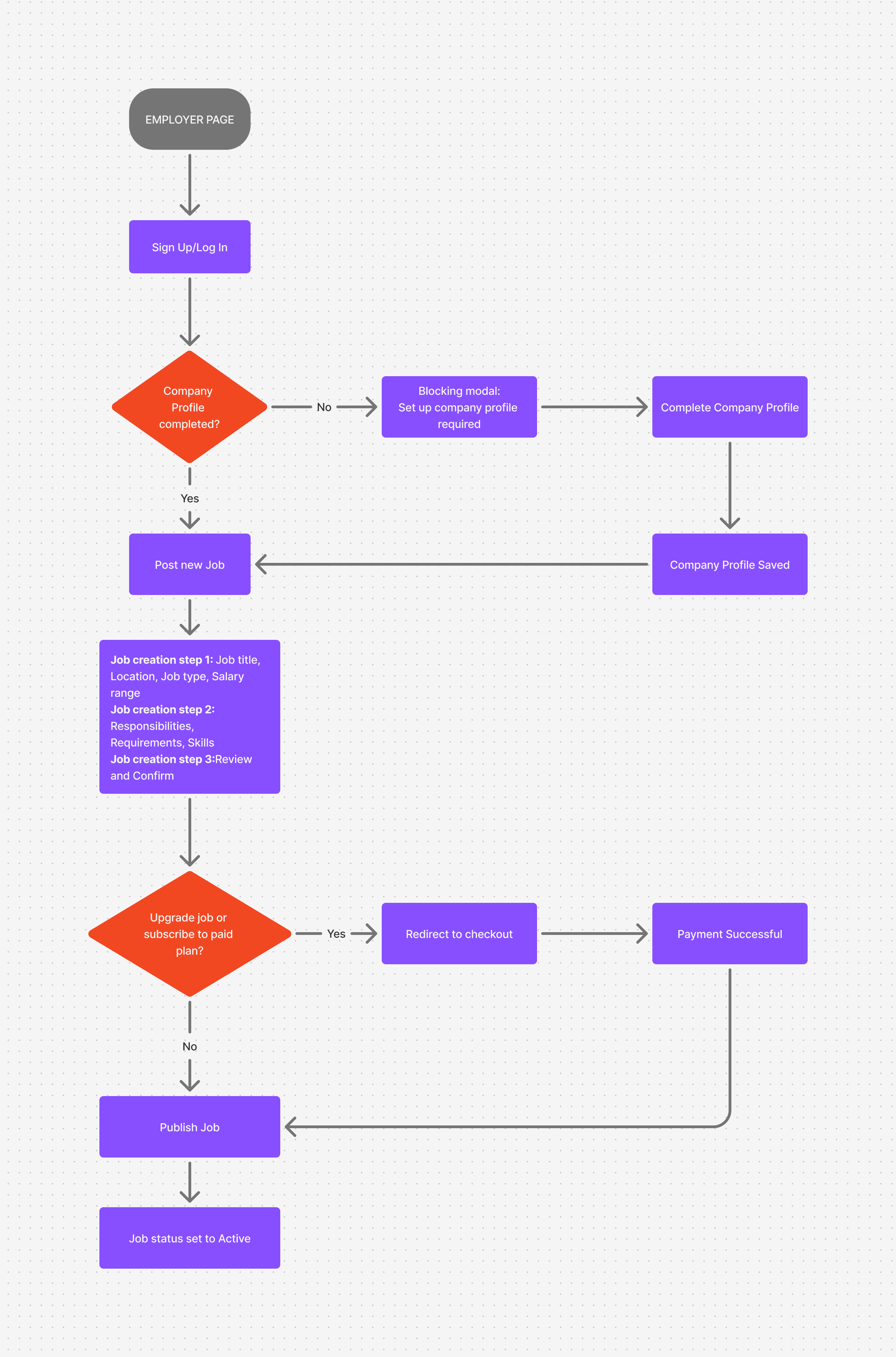
Recruiter Flow
VISUAL IDENTITY
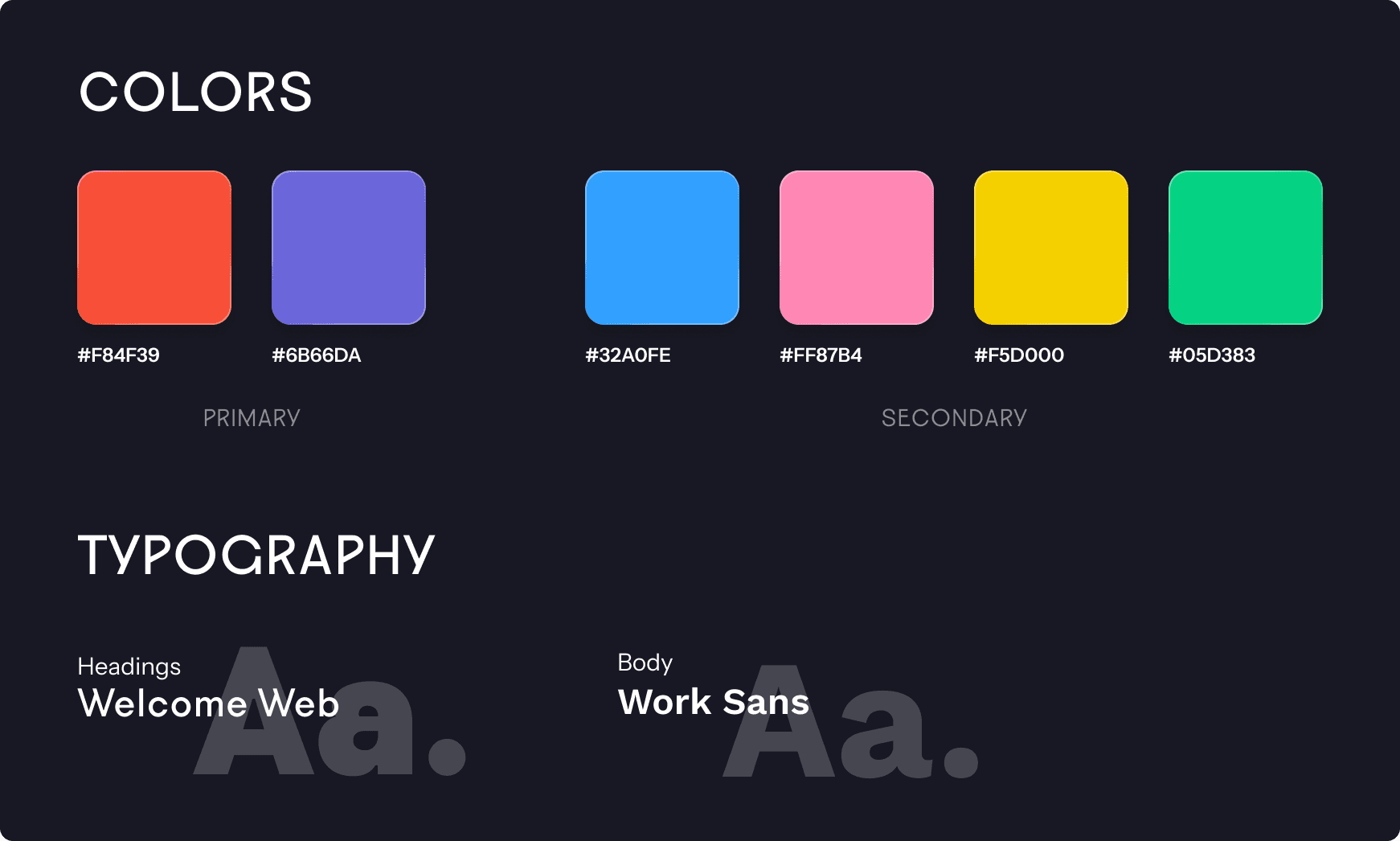
WEBSITE HOMEPAGE
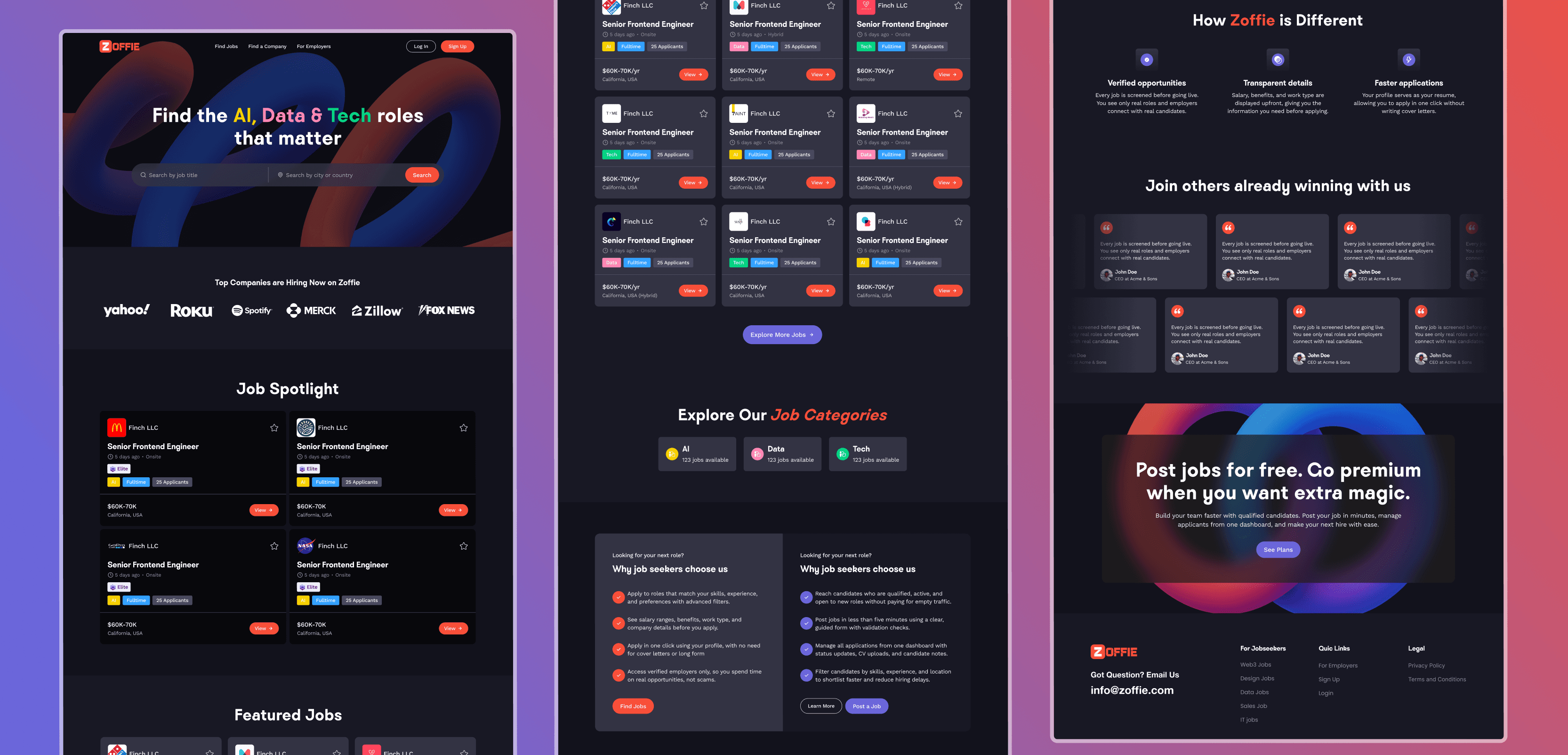
The website homepage is the alpha of the entire product; it sets expectations, frames trust, and routes users into the right path.
The homepage serves three purposes.
First, it helps job seekers understand what types of roles exist and whether Zoffie fits their goals.
Second, it shows employers what kind of hiring experience they are signing up for.
Third, it acts as a router into job search, employer signup, or account access.
The main goal was to ensure job seekers move toward discovery while employers move toward posting, with no one trapped in the wrong flow.
ONBOARDING
EMPLOYER EXPERIENCE
Company Profile Setup
Before an employer can post a job, Zoffie requires a complete company profile. This is a deliberate product decision and not a formality of onboarding.
Research has shown that when companies skip context, candidates apply with assumptions. Requiring a company profile moved clarity upstream.
This step is enforced through a blocking gate. If an employer attempts to post a job without completing the profile, the system pauses the flow and explains why setup is required.
The result is twofold.
Candidates arrive informed before applying.
Employers receive applicants who understand the company, not just the role title.
1-Company Profile(Incomplete); 2- Action Blocking Modal; 3,4,5,6-Set up Company Profile ; 7-Company Profile (Completed)
JOB POSTINGS
After the company profile has been completed, employers can create job postings.
The process of creating a job posting is broken into bite-sized, focused steps. I included inline guidance to explain strong inputs.
The applicant questions step allowed employers to ask specific niche questions needed to assess the best fit for the role. Other applicant details, such as resume, cover letter, contact info, links etc., are included by default in the application process by the system.
The preview step also plays a critical role, allowing employers to see the role exactly as candidates will.
Jobs can also be saved as drafts to be completed later.
1-Job Postings(Empty State); 2,3,4,5-Create New Job; 6-Preview Job Posting; 7-Success Modal; 8- Job Postings List
APPLICATION MANAGEMENT
Each job posting is divided into four(4) major tabs: Applications, Job Summary, Interview, and Analytics.
In Applications, employers could manage applicants’ details, with smart features to assist in their hiring process.
I implemented a status to track progress through the hiring process.
Shortlisting(Star) existed independently, so teams can mark interest without changing state.
Internal notes were included to stay private and structured letting employers add extra context to an applicant's application.
I introduced numeric ratings to allow comparison across candidates using shared criteria and to allow a fair vetting process.
Hiring and Rejection actions came with default communications that are sent to applicants to keep them updated.
1-Applications Tab; 2-Applicant Detail(Submission); 3-Numeric Rating; 4-Send Message; 5-Reject Modal; 6-Hire Modal; 7-Job Summary Tab
INTERVIEW HANDLING
We had to skip interview automation for Zoffie to keep the scope tight and streamline the development process.
Despite this limitation, we still needed to support real hiring workflows. I came up with a middle ground where the platform focuses on tracking interview intent and progress rather than running meetings.
When employers choose to schedule an interview, a modal captures intent. Interview type, date, and internal notes are recorded. Links and logistics live inside notes for reference, and each interview had statuses to track and reflect progress.
Interviews scheduled are added to each applicant's detail; multiple interviews can also be logged for a single applicant!
1-Interview Tab (Empty State); 2-Schedule Interview Modal; 3-Applicant with multiple interviews scheduled; 4- All Interviews List
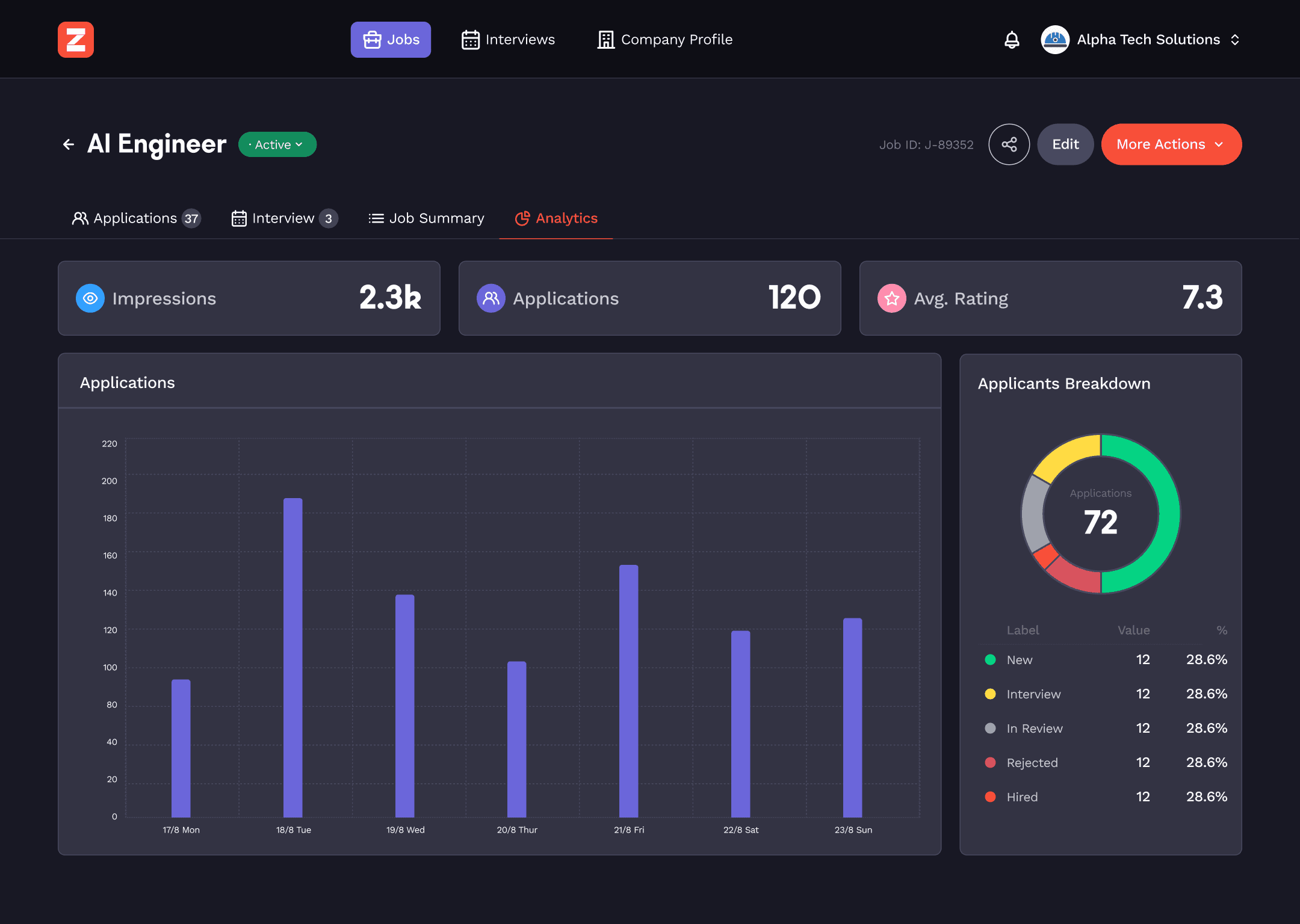
JOB ANALYTICS
Analytics exist to answer simple questions quickly.
Is the role being seen?
Are candidates applying?
Is interest converting into action?
Metrics stay lightweight and contextual to each job. There are no dashboards to learn
JOBSEEKERS EXPERIENCE
Profile and Preferences
Job seekers are encouraged to complete their profiles and preferences. This is framed as a benefit, not a requirement. A complete profile reduces friction during applications. Preferences improve matching and relevance. Low-intent applications drop naturally as clarity increases.
The application profile will also be used for quick applications. The opportunity to upload multiple resumes was included, as research showed most job seekers applied to jobs with tailored resumes.
Job seekers are encouraged to complete their profiles and preferences. This is framed as a benefit, not a requirement. A complete profile reduces friction during applications. Preferences improve matching and relevance. Low-intent applications drop naturally as clarity increases.
The application profile will also be used for quick applications. The opportunity to upload multiple resumes was included, as research showed most job seekers applied to jobs with tailored resumes.
1-Set Up job preference; 2-Set up application profile; 3-Manage application profile in settings; 4-Notification preferences.
JOB DISCOVERY
The job seekers dashboard removes the need to search from scratch every time. Pre-filtered groups surface roles based on relevance. Best matches highlight fit. Recently posted roles highlight freshness. Preference-based roles reinforce personalization.
The goal of this design was to lower effort and keep momentum high.
The job seekers dashboard removes the need to search from scratch every time. Pre-filtered groups surface roles based on relevance. Best matches highlight fit. Recently posted roles highlight freshness. Preference-based roles reinforce personalization.
The goal of this design was to lower effort and keep momentum high.
1- Jobseekers homepage/dashboard; 2- Search job page; 3-Job Details page; 4-Company page
APPLICATIONS
Applying for jobs needed to be straightforward.
For job seekers applying for the first time, they needed to go through the entire application process. However, for subsequent applications, formerly input data are saved, saving time.
Job seekers can view the full role context during application and before submitting, which I noticed most job board platforms lack.
Applying for jobs needed to be straightforward.
For job seekers applying for the first time, they needed to go through the entire application process. However, for subsequent applications, formerly input data are saved, saving time.
Job seekers can view the full role context during application and before submitting, which I noticed most job board platforms lack.
1-Apply for Job#1; 2- Select/Upload Resume; 3- Application Summary; 4-Success Screen; 5-Applications List
OTHER SCREENS
1-Notifications; 2- Billing & Subscription Settings; 3- Search by Company; 4- Manage Messages(for jobseekers)
WHAT WORKED
Clear job context reduced low-quality applications, but the real impact went beyond application count. By forcing employers to define salary ranges, role expectations, and company context upfront, the system shifted applicant behavior. Candidates self-selected more deliberately. Employers reported a shortened review time per candidate.
Independent shortlisting changed how hiring decisions were made. Most platforms overload status changes to mean interest, rejection, or progress. Separating shortlist from status allowed teams to express intent without breaking workflow logic. Recruiters could mark interest privately while keeping candidates in the correct process stage.
Numeric ratings created a common evaluation language across teams. Before this, feedback lived in notes and subjective comments. Introducing defined rating factors forced reviewers to articulate why a candidate felt strong or weak. Over time, this reduced vague feedback like “seems good” and replaced it with comparable signals across candidates. The value was not the number itself, but the discipline it introduced into decision making.
Company profiles increased candidate preparedness before the first interaction. Candidates arrived at interviews with context about the company, role purpose, and hiring intent. This reduced early misalignment conversations and improved interview quality. Employers noticed fewer basic clarification questions and more role-specific discussions.
Taken together, these outcomes showed that improving hiring quality required earlier intervention in the system, not more tooling at the end.
What I would improve next and why
I would expand analytics depth for paid employers, focused on decision quality rather than traffic. Metrics like time-to-first-shortlist, shortlist-to-hire ratio, and application review time would help teams understand where their hiring process breaks down.
I would introduce reusable evaluation templates for repeat hiring. Teams hiring for similar roles often recalibrate criteria from scratch. Templates would reduce setup time and increase consistency across hiring cycles.
I would introduce multi-user management for companies/employers to allow more than one recruiter in the hiring process, especially for medium to large-sized companies.
ZOFFIE
Designing A Hiring Platform Around Intent.
Zoffie is a live hiring platform built to help companies hire and help job seekers apply with intent. The product challenges the common hiring model where employers are overwhelmed with low-quality applications, and candidates apply without enough context.
Year
2025
Industry
SaaS
Client
Simar
Project Duration
6 weeks
PROBLEM SPACE
When I started looking closely at hiring platforms, I noticed a consistent pattern. Most platforms are designed to increase activity through more postings and more applications. Success is often measured by the number of candidates who apply, rather than by the number who are actually qualified.
I interviewed with several recruiters, and their frustration was palpable.
Several hiring managers described receiving over 100 applications within days, with only a small fraction being relevant. Many applicants lacked the required skills or misunderstood the role entirely.
On the jobseeker side, a different but connected problem appeared.
Candidates described applying without clarity. Salary ranges were missing, and role expectations were mostly vague. Company information was limited or nonexistent most times. Many job seekers said they applied based on titles alone, hoping the details would become clear later.
One candidate explained that applying felt like a gamble. Another said they often realized a role was a poor fit only after receiving a response, which wasted time on both sides.
Filtering tools and ATS features were intended to solve the problem after applications arrived. Our research showed the problem started much earlier, at the point of understanding and intent.
THE GOAL
To create a permanent, centralized digital archive where loved ones can share memories, stories, photos, and key life moments in a peaceful, dignified environment.
THE Challenge
Existing memorial platforms often feel dark, old-fashioned, or emotionally heavy. We needed the exact opposite.
Life-first, not death-first.
RESEARCH AND VALIDATION
To confirm this, I conducted interviews with employers and active job seekers across different roles and company sizes. These were semi-structured conversations focused on recent hiring or application experiences.
Employers highlighted three recurring issues.
Too many applications from candidates who did not understand the role.
Job descriptions copied from templates without real context.
No consistent way to evaluate candidates beyond resumes.
Job seekers raised their own set of pain points.
Unclear salary and expectations before applying.
Limited information about the company or team.
Little feedback or visibility after submitting applications.
Employers wanted candidates who applied with intent. Jobseekers wanted enough context to decide whether a role was worth applying for.
Instead of focusing on better filters, Zoffie needed to focus on better context. Instead of optimizing for application volume, the system needed to encourage informed decisions on both sides before an application ever happened.
This insight became the foundation for how jobs were posted, how company profiles were designed, and how applications were structured end-to-end.
DESIGN PRINCIPLES
Four principles guided the product.
Clarity : Every job and company should be understood before applying.
Signal over volume: Fewer applications with higher intent beat mass submissions.
Structure without rigidity: Support real workflows without forcing rigid ATS behavior.
Respect existing tools: Track hiring decisions without replacing calendars or email.
USER FLOWS
Job Seekers Flow
Recruiter Flow
VISUAL IDENTITY
WEBSITE HOMEPAGE
The website homepage is the alpha of the entire product; it sets expectations, frames trust, and routes users into the right path.
The homepage serves three purposes.
First, it helps job seekers understand what types of roles exist and whether Zoffie fits their goals.
Second, it shows employers what kind of hiring experience they are signing up for.
Third, it acts as a router into job search, employer signup, or account access.
The main goal was to ensure job seekers move toward discovery while employers move toward posting, with no one trapped in the wrong flow.
ONBOARDING
EMPLOYER EXPERIENCE
Company Profile Setup
Before an employer can post a job, Zoffie requires a complete company profile. This is a deliberate product decision and not a formality of onboarding.
Research has shown that when companies skip context, candidates apply with assumptions. Requiring a company profile moved clarity upstream.
This step is enforced through a blocking gate. If an employer attempts to post a job without completing the profile, the system pauses the flow and explains why setup is required.
The result is twofold.
Candidates arrive informed before applying.
Employers receive applicants who understand the company, not just the role title.
1-Company Profile(Incomplete); 2- Action Blocking Modal; 3,4,5,6-Set up Company Profile ; 7-Company Profile (Completed)
JOB POSTINGS
After the company profile has been completed, employers can create job postings.
The process of creating a job posting is broken into bite-sized, focused steps. I included inline guidance to explain strong inputs.
The applicant questions step allowed employers to ask specific niche questions needed to assess the best fit for the role. Other applicant details, such as resume, cover letter, contact info, links etc., are included by default in the application process by the system.
The preview step also plays a critical role, allowing employers to see the role exactly as candidates will.
Jobs can also be saved as drafts to be completed later.
1-Job Postings(Empty State); 2,3,4,5-Create New Job; 6-Preview Job Posting; 7-Success Modal; 8- Job Postings List
APPLICATION MANAGEMENT
Each job posting is divided into four(4) major tabs: Applications, Job Summary, Interview, and Analytics.
In Applications, employers could manage applicants’ details, with smart features to assist in their hiring process.
I implemented a status to track progress through the hiring process.
Shortlisting(Star) existed independently, so teams can mark interest without changing state.
Internal notes were included to stay private and structured letting employers add extra context to an applicant's application.
I introduced numeric ratings to allow comparison across candidates using shared criteria and to allow a fair vetting process.
Hiring and Rejection actions came with default communications that are sent to applicants to keep them updated.
1-Applications Tab; 2-Applicant Detail(Submission); 3-Numeric Rating; 4-Send Message; 5-Reject Modal; 6-Hire Modal; 7-Job Summary Tab
INTERVIEW HANDLING
We had to skip interview automation for Zoffie to keep the scope tight and streamline the development process.
Despite this limitation, we still needed to support real hiring workflows. I came up with a middle ground where the platform focuses on tracking interview intent and progress rather than running meetings.
When employers choose to schedule an interview, a modal captures intent. Interview type, date, and internal notes are recorded. Links and logistics live inside notes for reference, and each interview had statuses to track and reflect progress.
Interviews scheduled are added to each applicant's detail; multiple interviews can also be logged for a single applicant!
1-Interview Tab (Empty State); 2-Schedule Interview Modal; 3-Applicant with multiple interviews scheduled; 4- All Interviews List
JOB ANALYTICS
Analytics exist to answer simple questions quickly.
Is the role being seen?
Are candidates applying?
Is interest converting into action?
Metrics stay lightweight and contextual to each job. There are no dashboards to learn
JOBSEEKERS EXPERIENCE
Profile and Preferences
Job seekers are encouraged to complete their profiles and preferences. This is framed as a benefit, not a requirement. A complete profile reduces friction during applications. Preferences improve matching and relevance. Low-intent applications drop naturally as clarity increases.
The application profile will also be used for quick applications. The opportunity to upload multiple resumes was included, as research showed most job seekers applied to jobs with tailored resumes.
Job seekers are encouraged to complete their profiles and preferences. This is framed as a benefit, not a requirement. A complete profile reduces friction during applications. Preferences improve matching and relevance. Low-intent applications drop naturally as clarity increases.
The application profile will also be used for quick applications. The opportunity to upload multiple resumes was included, as research showed most job seekers applied to jobs with tailored resumes.
1-Set Up job preference; 2-Set up application profile; 3-Manage application profile in settings; 4-Notification preferences.
JOB DISCOVERY
The job seekers dashboard removes the need to search from scratch every time. Pre-filtered groups surface roles based on relevance. Best matches highlight fit. Recently posted roles highlight freshness. Preference-based roles reinforce personalization.
The goal of this design was to lower effort and keep momentum high.
The job seekers dashboard removes the need to search from scratch every time. Pre-filtered groups surface roles based on relevance. Best matches highlight fit. Recently posted roles highlight freshness. Preference-based roles reinforce personalization.
The goal of this design was to lower effort and keep momentum high.
1- Jobseekers homepage/dashboard; 2- Search job page; 3-Job Details page; 4-Company page
APPLICATIONS
Applying for jobs needed to be straightforward.
For job seekers applying for the first time, they needed to go through the entire application process. However, for subsequent applications, formerly input data are saved, saving time.
Job seekers can view the full role context during application and before submitting, which I noticed most job board platforms lack.
Applying for jobs needed to be straightforward.
For job seekers applying for the first time, they needed to go through the entire application process. However, for subsequent applications, formerly input data are saved, saving time.
Job seekers can view the full role context during application and before submitting, which I noticed most job board platforms lack.
1-Apply for Job#1; 2- Select/Upload Resume; 3- Application Summary; 4-Success Screen; 5-Applications List
OTHER SCREENS
1-Notifications; 2- Billing & Subscription Settings; 3- Search by Company; 4- Manage Messages(for jobseekers)
WHAT WORKED
Clear job context reduced low-quality applications, but the real impact went beyond application count. By forcing employers to define salary ranges, role expectations, and company context upfront, the system shifted applicant behavior. Candidates self-selected more deliberately. Employers reported a shortened review time per candidate.
Independent shortlisting changed how hiring decisions were made. Most platforms overload status changes to mean interest, rejection, or progress. Separating shortlist from status allowed teams to express intent without breaking workflow logic. Recruiters could mark interest privately while keeping candidates in the correct process stage.
Numeric ratings created a common evaluation language across teams. Before this, feedback lived in notes and subjective comments. Introducing defined rating factors forced reviewers to articulate why a candidate felt strong or weak. Over time, this reduced vague feedback like “seems good” and replaced it with comparable signals across candidates. The value was not the number itself, but the discipline it introduced into decision making.
Company profiles increased candidate preparedness before the first interaction. Candidates arrived at interviews with context about the company, role purpose, and hiring intent. This reduced early misalignment conversations and improved interview quality. Employers noticed fewer basic clarification questions and more role-specific discussions.
Taken together, these outcomes showed that improving hiring quality required earlier intervention in the system, not more tooling at the end.
What I would improve next and why
I would expand analytics depth for paid employers, focused on decision quality rather than traffic. Metrics like time-to-first-shortlist, shortlist-to-hire ratio, and application review time would help teams understand where their hiring process breaks down.
I would introduce reusable evaluation templates for repeat hiring. Teams hiring for similar roles often recalibrate criteria from scratch. Templates would reduce setup time and increase consistency across hiring cycles.
I would introduce multi-user management for companies/employers to allow more than one recruiter in the hiring process, especially for medium to large-sized companies.
ZOFFIE
Designing A Hiring Platform Around Intent.
Zoffie is a live hiring platform built to help companies hire and help job seekers apply with intent. The product challenges the common hiring model where employers are overwhelmed with low-quality applications, and candidates apply without enough context.
Year
2025
Industry
SaaS
Client
Simar
Project Duration
6 weeks
PROBLEM SPACE
When I started looking closely at hiring platforms, I noticed a consistent pattern. Most platforms are designed to increase activity through more postings and more applications. Success is often measured by the number of candidates who apply, rather than by the number who are actually qualified.
I interviewed with several recruiters, and their frustration was palpable.
Several hiring managers described receiving over 100 applications within days, with only a small fraction being relevant. Many applicants lacked the required skills or misunderstood the role entirely.
On the jobseeker side, a different but connected problem appeared.
Candidates described applying without clarity. Salary ranges were missing, and role expectations were mostly vague. Company information was limited or nonexistent most times. Many job seekers said they applied based on titles alone, hoping the details would become clear later.
One candidate explained that applying felt like a gamble. Another said they often realized a role was a poor fit only after receiving a response, which wasted time on both sides.
Filtering tools and ATS features were intended to solve the problem after applications arrived. Our research showed the problem started much earlier, at the point of understanding and intent.
THE GOAL
To create a permanent, centralized digital archive where loved ones can share memories, stories, photos, and key life moments in a peaceful, dignified environment.
THE Challenge
Existing memorial platforms often feel dark, old-fashioned, or emotionally heavy. We needed the exact opposite.
Life-first, not death-first.
RESEARCH AND VALIDATION
To confirm this, I conducted interviews with employers and active job seekers across different roles and company sizes. These were semi-structured conversations focused on recent hiring or application experiences.
Employers highlighted three recurring issues.
Too many applications from candidates who did not understand the role.
Job descriptions copied from templates without real context.
No consistent way to evaluate candidates beyond resumes.
Job seekers raised their own set of pain points.
Unclear salary and expectations before applying.
Limited information about the company or team.
Little feedback or visibility after submitting applications.
Employers wanted candidates who applied with intent. Jobseekers wanted enough context to decide whether a role was worth applying for.
Instead of focusing on better filters, Zoffie needed to focus on better context. Instead of optimizing for application volume, the system needed to encourage informed decisions on both sides before an application ever happened.
This insight became the foundation for how jobs were posted, how company profiles were designed, and how applications were structured end-to-end.
DESIGN PRINCIPLES
Four principles guided the product.
Clarity : Every job and company should be understood before applying.
Signal over volume: Fewer applications with higher intent beat mass submissions.
Structure without rigidity: Support real workflows without forcing rigid ATS behavior.
Respect existing tools: Track hiring decisions without replacing calendars or email.
USER FLOWS
Job Seekers Flow
Recruiter Flow
VISUAL IDENTITY
WEBSITE HOMEPAGE
The website homepage is the alpha of the entire product; it sets expectations, frames trust, and routes users into the right path.
The homepage serves three purposes.
First, it helps job seekers understand what types of roles exist and whether Zoffie fits their goals.
Second, it shows employers what kind of hiring experience they are signing up for.
Third, it acts as a router into job search, employer signup, or account access.
The main goal was to ensure job seekers move toward discovery while employers move toward posting, with no one trapped in the wrong flow.
ONBOARDING
EMPLOYER EXPERIENCE
Company Profile Setup
Before an employer can post a job, Zoffie requires a complete company profile. This is a deliberate product decision and not a formality of onboarding.
Research has shown that when companies skip context, candidates apply with assumptions. Requiring a company profile moved clarity upstream.
This step is enforced through a blocking gate. If an employer attempts to post a job without completing the profile, the system pauses the flow and explains why setup is required.
The result is twofold.
Candidates arrive informed before applying.
Employers receive applicants who understand the company, not just the role title.
1-Company Profile(Incomplete); 2- Action Blocking Modal; 3,4,5,6-Set up Company Profile ; 7-Company Profile (Completed)
JOB POSTINGS
After the company profile has been completed, employers can create job postings.
The process of creating a job posting is broken into bite-sized, focused steps. I included inline guidance to explain strong inputs.
The applicant questions step allowed employers to ask specific niche questions needed to assess the best fit for the role. Other applicant details, such as resume, cover letter, contact info, links etc., are included by default in the application process by the system.
The preview step also plays a critical role, allowing employers to see the role exactly as candidates will.
Jobs can also be saved as drafts to be completed later.
1-Job Postings(Empty State); 2,3,4,5-Create New Job; 6-Preview Job Posting; 7-Success Modal; 8- Job Postings List
APPLICATION MANAGEMENT
Each job posting is divided into four(4) major tabs: Applications, Job Summary, Interview, and Analytics.
In Applications, employers could manage applicants’ details, with smart features to assist in their hiring process.
I implemented a status to track progress through the hiring process.
Shortlisting(Star) existed independently, so teams can mark interest without changing state.
Internal notes were included to stay private and structured letting employers add extra context to an applicant's application.
I introduced numeric ratings to allow comparison across candidates using shared criteria and to allow a fair vetting process.
Hiring and Rejection actions came with default communications that are sent to applicants to keep them updated.
1-Applications Tab; 2-Applicant Detail(Submission); 3-Numeric Rating; 4-Send Message; 5-Reject Modal; 6-Hire Modal; 7-Job Summary Tab
INTERVIEW HANDLING
We had to skip interview automation for Zoffie to keep the scope tight and streamline the development process.
Despite this limitation, we still needed to support real hiring workflows. I came up with a middle ground where the platform focuses on tracking interview intent and progress rather than running meetings.
When employers choose to schedule an interview, a modal captures intent. Interview type, date, and internal notes are recorded. Links and logistics live inside notes for reference, and each interview had statuses to track and reflect progress.
Interviews scheduled are added to each applicant's detail; multiple interviews can also be logged for a single applicant!
1-Interview Tab (Empty State); 2-Schedule Interview Modal; 3-Applicant with multiple interviews scheduled; 4- All Interviews List
JOB ANALYTICS
Analytics exist to answer simple questions quickly.
Is the role being seen?
Are candidates applying?
Is interest converting into action?
Metrics stay lightweight and contextual to each job. There are no dashboards to learn
JOBSEEKERS EXPERIENCE
Profile and Preferences
Job seekers are encouraged to complete their profiles and preferences. This is framed as a benefit, not a requirement. A complete profile reduces friction during applications. Preferences improve matching and relevance. Low-intent applications drop naturally as clarity increases.
The application profile will also be used for quick applications. The opportunity to upload multiple resumes was included, as research showed most job seekers applied to jobs with tailored resumes.
Job seekers are encouraged to complete their profiles and preferences. This is framed as a benefit, not a requirement. A complete profile reduces friction during applications. Preferences improve matching and relevance. Low-intent applications drop naturally as clarity increases.
The application profile will also be used for quick applications. The opportunity to upload multiple resumes was included, as research showed most job seekers applied to jobs with tailored resumes.
1-Set Up job preference; 2-Set up application profile; 3-Manage application profile in settings; 4-Notification preferences.
JOB DISCOVERY
The job seekers dashboard removes the need to search from scratch every time. Pre-filtered groups surface roles based on relevance. Best matches highlight fit. Recently posted roles highlight freshness. Preference-based roles reinforce personalization.
The goal of this design was to lower effort and keep momentum high.
The job seekers dashboard removes the need to search from scratch every time. Pre-filtered groups surface roles based on relevance. Best matches highlight fit. Recently posted roles highlight freshness. Preference-based roles reinforce personalization.
The goal of this design was to lower effort and keep momentum high.
1- Jobseekers homepage/dashboard; 2- Search job page; 3-Job Details page; 4-Company page
APPLICATIONS
Applying for jobs needed to be straightforward.
For job seekers applying for the first time, they needed to go through the entire application process. However, for subsequent applications, formerly input data are saved, saving time.
Job seekers can view the full role context during application and before submitting, which I noticed most job board platforms lack.
Applying for jobs needed to be straightforward.
For job seekers applying for the first time, they needed to go through the entire application process. However, for subsequent applications, formerly input data are saved, saving time.
Job seekers can view the full role context during application and before submitting, which I noticed most job board platforms lack.
1-Apply for Job#1; 2- Select/Upload Resume; 3- Application Summary; 4-Success Screen; 5-Applications List
OTHER SCREENS
1-Notifications; 2- Billing & Subscription Settings; 3- Search by Company; 4- Manage Messages(for jobseekers)
WHAT WORKED
Clear job context reduced low-quality applications, but the real impact went beyond application count. By forcing employers to define salary ranges, role expectations, and company context upfront, the system shifted applicant behavior. Candidates self-selected more deliberately. Employers reported a shortened review time per candidate.
Independent shortlisting changed how hiring decisions were made. Most platforms overload status changes to mean interest, rejection, or progress. Separating shortlist from status allowed teams to express intent without breaking workflow logic. Recruiters could mark interest privately while keeping candidates in the correct process stage.
Numeric ratings created a common evaluation language across teams. Before this, feedback lived in notes and subjective comments. Introducing defined rating factors forced reviewers to articulate why a candidate felt strong or weak. Over time, this reduced vague feedback like “seems good” and replaced it with comparable signals across candidates. The value was not the number itself, but the discipline it introduced into decision making.
Company profiles increased candidate preparedness before the first interaction. Candidates arrived at interviews with context about the company, role purpose, and hiring intent. This reduced early misalignment conversations and improved interview quality. Employers noticed fewer basic clarification questions and more role-specific discussions.
Taken together, these outcomes showed that improving hiring quality required earlier intervention in the system, not more tooling at the end.
What I would improve next and why
I would expand analytics depth for paid employers, focused on decision quality rather than traffic. Metrics like time-to-first-shortlist, shortlist-to-hire ratio, and application review time would help teams understand where their hiring process breaks down.
I would introduce reusable evaluation templates for repeat hiring. Teams hiring for similar roles often recalibrate criteria from scratch. Templates would reduce setup time and increase consistency across hiring cycles.
I would introduce multi-user management for companies/employers to allow more than one recruiter in the hiring process, especially for medium to large-sized companies.