Users Are Stupid: The Curse of Knowledge in Products
Users Are Stupid: The Curse of Knowledge in Products
Users Are Stupid: The Curse of Knowledge in Products
In 1990, Stanford’s Elizabeth Newton proved that when we know something, we can't imagine not knowing it. Read how the curse of knowledge affects product development.
Insights
Jan 3, 2026
“Remember, users are stupid,” my CEO would say, as he read a user’s inquiry where they had misunderstood a flow or missed the obvious. “We need to keep it simple, stupid? They just aren’t getting it.”
It’s a comforting thought, isn’t it? If a feature rollout fails, it’s because the audience lacked the IQ to appreciate the genius of our interface. But there is a more uncomfortable truth lurking beneath. It’s not that your users are slow; it’s that you are suffering from a psychological phenomenon that makes you a terrible judge of your own work.
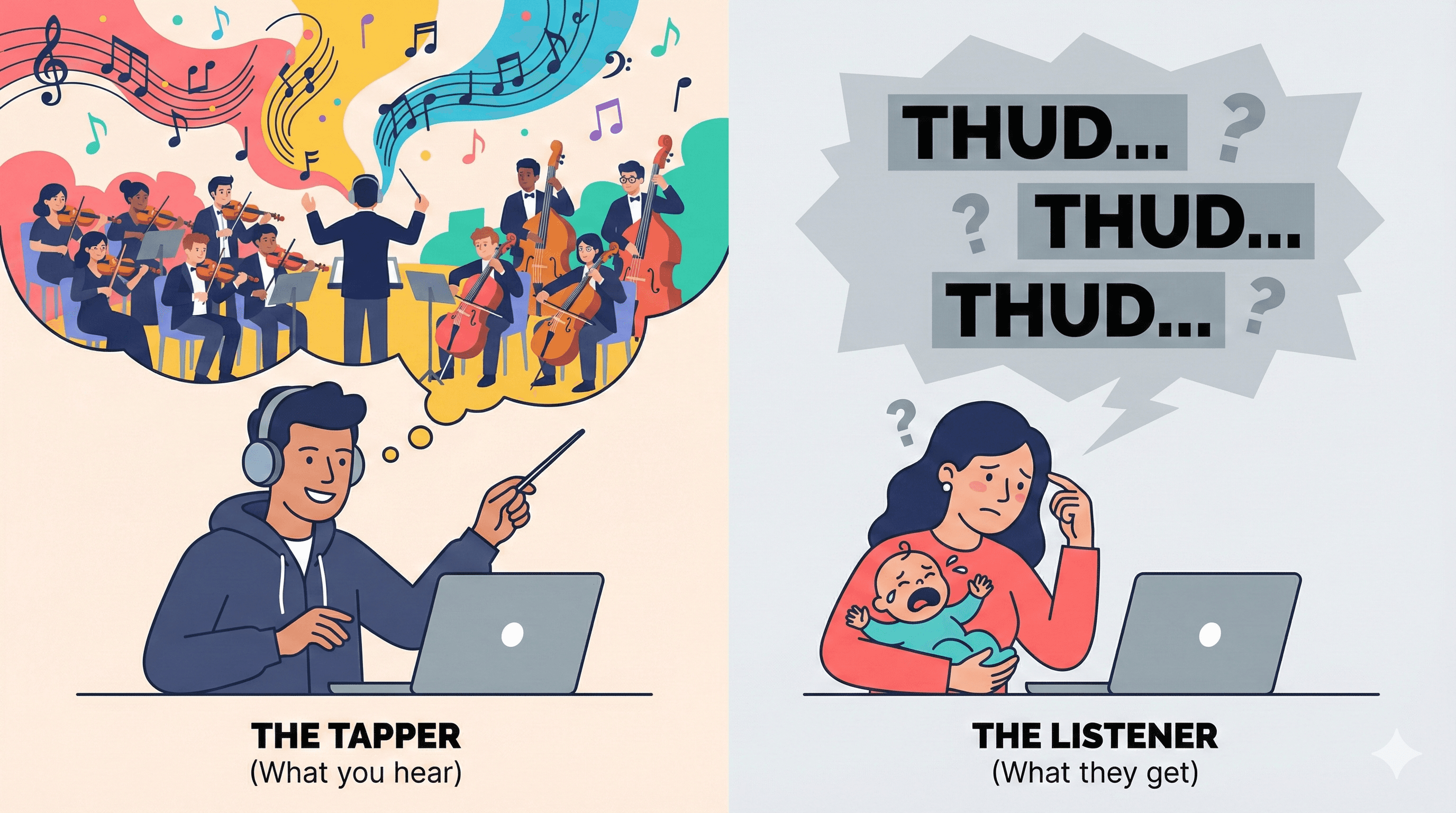
This is the oldest trap in product design and leadership. The gap between intent and reality. Between what creators mean and what users experience. Between the symphony in the boardroom and the dull thud on the customer’s desk.
You are a “Tapper,” and you’ve forgotten what it’s like to be a “Listener.”
The Symphony in Your Head
In 1990, a Stanford doctoral student named Elizabeth Newton conducted a remarkably simple experiment. She assigned people to one of two roles: “Tappers” or “Listeners.” The Tappers were asked to pick a well-known song — think Happy Birthday or the national anthem — and tap out the rhythm on a table. The Listeners had to guess the song.
Before the tapping began, the Tappers predicted that the Listeners would guess the song correctly about 50% of the time. They were confident. After all, the melody was so obvious.
The actual result? The Listeners guessed the song correctly only just 2.5% of the time.
For the Tapper, the experience is immersive. As they knock their knuckles on the wood, they are “hearing” the lyrics, the drums, and the soaring chorus in their head. But for the Listener, there is no music. There is only a series of erratic, disconnected, and deeply annoying thuds stripped of all context.
The Curse of Product Design
This is the “Curse of Knowledge.” Once we know something, we find it almost impossible to imagine what it was like not to know it.
When a CEO, a Product Manager, or a Lead Designer looks at a dashboard they’ve spent six months obsessing over, they aren’t just seeing the screens. They are “hearing” the backend architecture, the strategic goals, and the hours of debate that led to that specific shade of blue. To them, the product is a symphony.
But to the new user? The user who is tired, distracted, and trying to solve a problem in three minutes before their next meeting? Your product isn’t a symphony. It’s just rhythmic tapping on a table.
When we say “the user is stupid,” what we’re actually saying is, “I am frustrated that the user can’t hear the music playing inside my own head.” We’ve designed for our own context, not their reality.
Breaking the Silence
To move from a frustrated Tapper to a successful creator, we have to stop assuming our “melody” is self-evident. Establishing true product leadership requires a radical shift in how we view the “stupid” user.
First, we must embrace the “Outsider Audit.” Most teams test their products on people within their own industry. This is a mistake. You don’t need a domain expert; you need a “professional amateur.” You need someone who hasn’t been breathing your company’s CO2 for the last year to tell you that your “intuitive” navigation feels like a labyrinth.
Second, design for the distracted. We often build products assuming the user is giving us 100% of their cognitive load. In reality, they are giving us about 10%, while 90% is occupied by their crying toddler or their overflowing inbox. If your product requires a “symphony” of focus to understand, you’ve already lost.
Finally, kill the context. If a button requires a tooltip to explain what it does, the “tapping” has failed. Great design doesn’t ask the user to learn a new tune; it uses the melodies they already know.
The next time you’re tempted to blame the user for “not getting it,” take a breath and look at the table. Remind yourself that you are the one with the music in your head. The user isn’t stupid; they’re just waiting for you to stop thumping and start composing something they can actually hear.
Peace.
More to Discover

Users Are Stupid: The Curse of Knowledge in Products
Users Are Stupid: The Curse of Knowledge in Products
Users Are Stupid: The Curse of Knowledge in Products
In 1990, Stanford’s Elizabeth Newton proved that when we know something, we can't imagine not knowing it. Read how the curse of knowledge affects product development.
Insights
Jan 3, 2026
“Remember, users are stupid,” my CEO would say, as he read a user’s inquiry where they had misunderstood a flow or missed the obvious. “We need to keep it simple, stupid? They just aren’t getting it.”
It’s a comforting thought, isn’t it? If a feature rollout fails, it’s because the audience lacked the IQ to appreciate the genius of our interface. But there is a more uncomfortable truth lurking beneath. It’s not that your users are slow; it’s that you are suffering from a psychological phenomenon that makes you a terrible judge of your own work.
This is the oldest trap in product design and leadership. The gap between intent and reality. Between what creators mean and what users experience. Between the symphony in the boardroom and the dull thud on the customer’s desk.
You are a “Tapper,” and you’ve forgotten what it’s like to be a “Listener.”
The Symphony in Your Head
In 1990, a Stanford doctoral student named Elizabeth Newton conducted a remarkably simple experiment. She assigned people to one of two roles: “Tappers” or “Listeners.” The Tappers were asked to pick a well-known song — think Happy Birthday or the national anthem — and tap out the rhythm on a table. The Listeners had to guess the song.
Before the tapping began, the Tappers predicted that the Listeners would guess the song correctly about 50% of the time. They were confident. After all, the melody was so obvious.
The actual result? The Listeners guessed the song correctly only just 2.5% of the time.
For the Tapper, the experience is immersive. As they knock their knuckles on the wood, they are “hearing” the lyrics, the drums, and the soaring chorus in their head. But for the Listener, there is no music. There is only a series of erratic, disconnected, and deeply annoying thuds stripped of all context.
The Curse of Product Design
This is the “Curse of Knowledge.” Once we know something, we find it almost impossible to imagine what it was like not to know it.
When a CEO, a Product Manager, or a Lead Designer looks at a dashboard they’ve spent six months obsessing over, they aren’t just seeing the screens. They are “hearing” the backend architecture, the strategic goals, and the hours of debate that led to that specific shade of blue. To them, the product is a symphony.
But to the new user? The user who is tired, distracted, and trying to solve a problem in three minutes before their next meeting? Your product isn’t a symphony. It’s just rhythmic tapping on a table.
When we say “the user is stupid,” what we’re actually saying is, “I am frustrated that the user can’t hear the music playing inside my own head.” We’ve designed for our own context, not their reality.
Breaking the Silence
To move from a frustrated Tapper to a successful creator, we have to stop assuming our “melody” is self-evident. Establishing true product leadership requires a radical shift in how we view the “stupid” user.
First, we must embrace the “Outsider Audit.” Most teams test their products on people within their own industry. This is a mistake. You don’t need a domain expert; you need a “professional amateur.” You need someone who hasn’t been breathing your company’s CO2 for the last year to tell you that your “intuitive” navigation feels like a labyrinth.
Second, design for the distracted. We often build products assuming the user is giving us 100% of their cognitive load. In reality, they are giving us about 10%, while 90% is occupied by their crying toddler or their overflowing inbox. If your product requires a “symphony” of focus to understand, you’ve already lost.
Finally, kill the context. If a button requires a tooltip to explain what it does, the “tapping” has failed. Great design doesn’t ask the user to learn a new tune; it uses the melodies they already know.
The next time you’re tempted to blame the user for “not getting it,” take a breath and look at the table. Remind yourself that you are the one with the music in your head. The user isn’t stupid; they’re just waiting for you to stop thumping and start composing something they can actually hear.
Peace.
More to Discover
Users Are Stupid: The Curse of Knowledge in Products
Users Are Stupid: The Curse of Knowledge in Products
Users Are Stupid: The Curse of Knowledge in Products
In 1990, Stanford’s Elizabeth Newton proved that when we know something, we can't imagine not knowing it. Read how the curse of knowledge affects product development.
Insights
Jan 3, 2026
“Remember, users are stupid,” my CEO would say, as he read a user’s inquiry where they had misunderstood a flow or missed the obvious. “We need to keep it simple, stupid? They just aren’t getting it.”
It’s a comforting thought, isn’t it? If a feature rollout fails, it’s because the audience lacked the IQ to appreciate the genius of our interface. But there is a more uncomfortable truth lurking beneath. It’s not that your users are slow; it’s that you are suffering from a psychological phenomenon that makes you a terrible judge of your own work.
This is the oldest trap in product design and leadership. The gap between intent and reality. Between what creators mean and what users experience. Between the symphony in the boardroom and the dull thud on the customer’s desk.
You are a “Tapper,” and you’ve forgotten what it’s like to be a “Listener.”
The Symphony in Your Head
In 1990, a Stanford doctoral student named Elizabeth Newton conducted a remarkably simple experiment. She assigned people to one of two roles: “Tappers” or “Listeners.” The Tappers were asked to pick a well-known song — think Happy Birthday or the national anthem — and tap out the rhythm on a table. The Listeners had to guess the song.
Before the tapping began, the Tappers predicted that the Listeners would guess the song correctly about 50% of the time. They were confident. After all, the melody was so obvious.
The actual result? The Listeners guessed the song correctly only just 2.5% of the time.
For the Tapper, the experience is immersive. As they knock their knuckles on the wood, they are “hearing” the lyrics, the drums, and the soaring chorus in their head. But for the Listener, there is no music. There is only a series of erratic, disconnected, and deeply annoying thuds stripped of all context.
The Curse of Product Design
This is the “Curse of Knowledge.” Once we know something, we find it almost impossible to imagine what it was like not to know it.
When a CEO, a Product Manager, or a Lead Designer looks at a dashboard they’ve spent six months obsessing over, they aren’t just seeing the screens. They are “hearing” the backend architecture, the strategic goals, and the hours of debate that led to that specific shade of blue. To them, the product is a symphony.
But to the new user? The user who is tired, distracted, and trying to solve a problem in three minutes before their next meeting? Your product isn’t a symphony. It’s just rhythmic tapping on a table.
When we say “the user is stupid,” what we’re actually saying is, “I am frustrated that the user can’t hear the music playing inside my own head.” We’ve designed for our own context, not their reality.
Breaking the Silence
To move from a frustrated Tapper to a successful creator, we have to stop assuming our “melody” is self-evident. Establishing true product leadership requires a radical shift in how we view the “stupid” user.
First, we must embrace the “Outsider Audit.” Most teams test their products on people within their own industry. This is a mistake. You don’t need a domain expert; you need a “professional amateur.” You need someone who hasn’t been breathing your company’s CO2 for the last year to tell you that your “intuitive” navigation feels like a labyrinth.
Second, design for the distracted. We often build products assuming the user is giving us 100% of their cognitive load. In reality, they are giving us about 10%, while 90% is occupied by their crying toddler or their overflowing inbox. If your product requires a “symphony” of focus to understand, you’ve already lost.
Finally, kill the context. If a button requires a tooltip to explain what it does, the “tapping” has failed. Great design doesn’t ask the user to learn a new tune; it uses the melodies they already know.
The next time you’re tempted to blame the user for “not getting it,” take a breath and look at the table. Remind yourself that you are the one with the music in your head. The user isn’t stupid; they’re just waiting for you to stop thumping and start composing something they can actually hear.
Peace.